
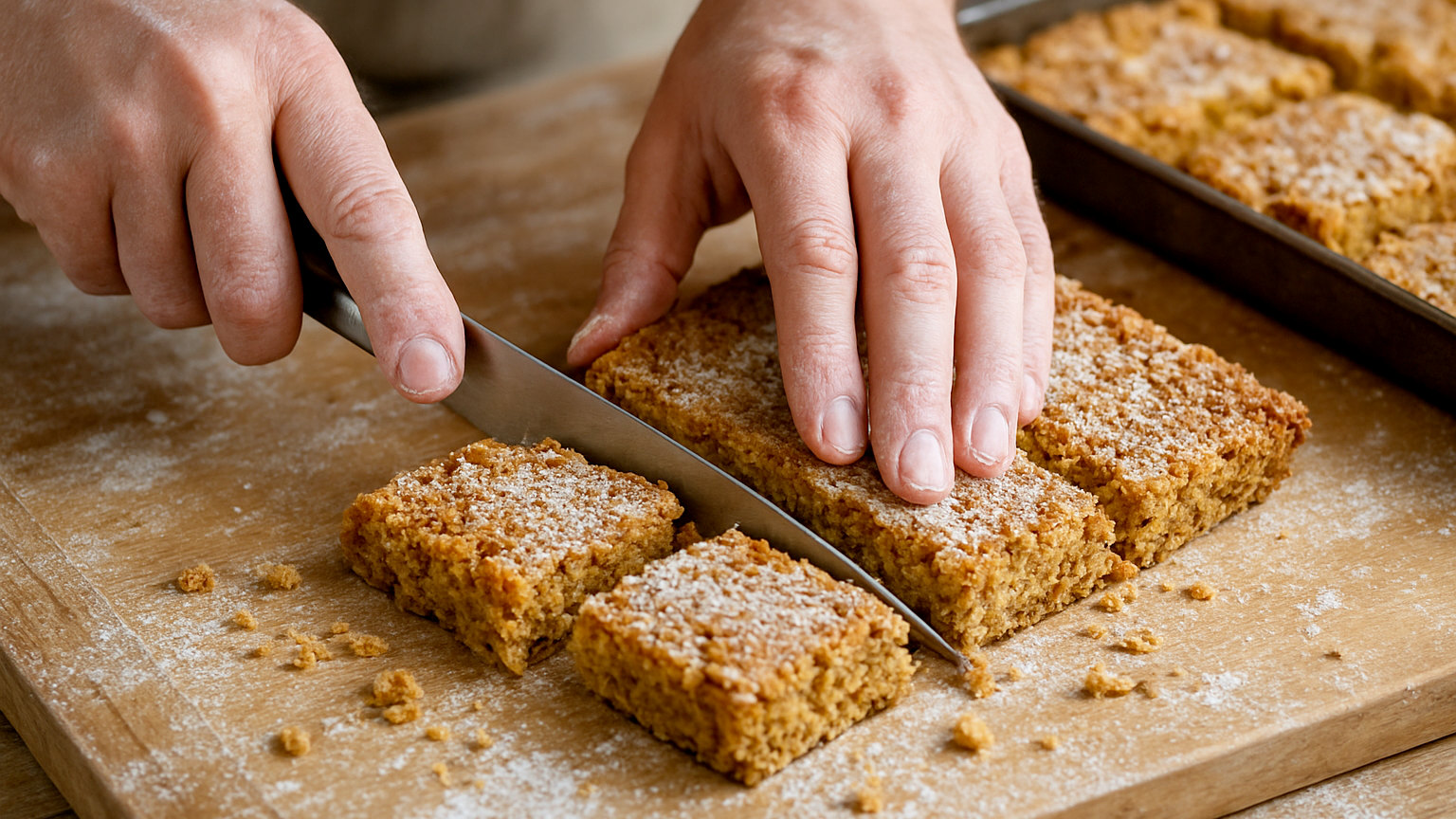
Flapjacks are four ingredients melted together and baked, and they are among the easiest things in this section. The two questions are chewy or crunchy, which is decided by baking time, and why they fall apart, which is almost always because they were cut at the wrong moment. Both are easy to control.
What do you need for 16 pieces?
- 250g rolled oats
- 175g butter
- 125g light brown soft sugar
- 100g golden syrup
- A good pinch of salt
How do you make them?
- Heat the oven to 160C fan, 180C conventional, gas mark 4.
- Line a 20cm square tin with baking paper.
- Melt the butter, sugar, syrup and salt together over a low heat.
- Stir until the sugar has dissolved, without boiling.
- Take off the heat and stir in the oats until evenly coated.
- Press firmly into the tin and level the top.
- Bake for 20 minutes for chewy or 28 for crunchy.
- Mark into squares after 10 minutes of cooling, then leave in the tin until completely cold.
Score them warm, lift them out cold. Cutting hot flapjack makes it crumble and cutting it cold shatters it. Score the lines when it is warm and firm, then leave it alone until it has set completely.
What is the ratio?
Roughly 250g oats to 175g butter and 225g total sugars. More syrup gives a chewier, stickier flapjack and more oats a drier, crumblier one.
Why do they fall apart?
Not enough syrup, not pressed down firmly enough, or cut before they were cold.
Golden syrup is the glue. Reducing it in the interests of health is the usual reason a flapjack collapses.
Chewy or crunchy?
Twenty minutes gives a pale, soft, chewy flapjack. Twenty eight gives a darker, crisper one that snaps.
Both are correct and households tend to have firm views.
Does the tin need greasing as well?
Lining with paper is enough, since the mixture is already very buttery. Leave an overhang so you can lift the slab out whole.
Which oats should you use?
Standard rolled porridge oats. Jumbo oats give a chunkier, more rustic flapjack and instant oats turn pasty.
A mixture of rolled and jumbo gives good texture.
Should the mixture boil?
No. Just melt it until the sugar dissolves. Boiling starts to caramelise the syrup and makes the finished flapjack hard.
How firmly should they be pressed?
Very. Use the back of a spoon or a potato masher and compact the mixture properly, which is what holds it together.
A loosely spooned flapjack will crumble however long it cools.
What can you add?
Sultanas, chopped apricots, dried cranberries, seeds, chopped nuts or a handful of chocolate chips stirred in once cooled slightly.
Keep additions to about 100g so the oats still bind.
Can you add a topping?
Melted chocolate spread over the cooled slab and left to set turns them into something closer to a traybake.
Score the squares before the chocolate hardens, or it shatters when cut.
Can they be made healthier?
A little. Mashed banana or apple puree can replace some sugar, though the texture becomes cakier and they keep less well.
A flapjack is a butter and syrup biscuit and there is a limit to how far it can be reformed.
What size tin should you use?
A 20cm square for this quantity, which gives flapjacks about 2cm deep. A larger tin gives thin, dry ones.
Line it with paper so the whole slab lifts out in one piece.
Are they a biscuit or a traybake?
Somewhere between the two, which is why they appear under both. They are baked as a slab and cut like a traybake but eaten like a biscuit.
In America the word flapjack means a pancake, which causes regular confusion.
How long do they keep?
A week in an airtight tin. They freeze for three months, cut into squares and wrapped individually.
They defrost in about half an hour and travel well in a lunchbox.
See also Shortbread, or browse more Puddings recipes.

