
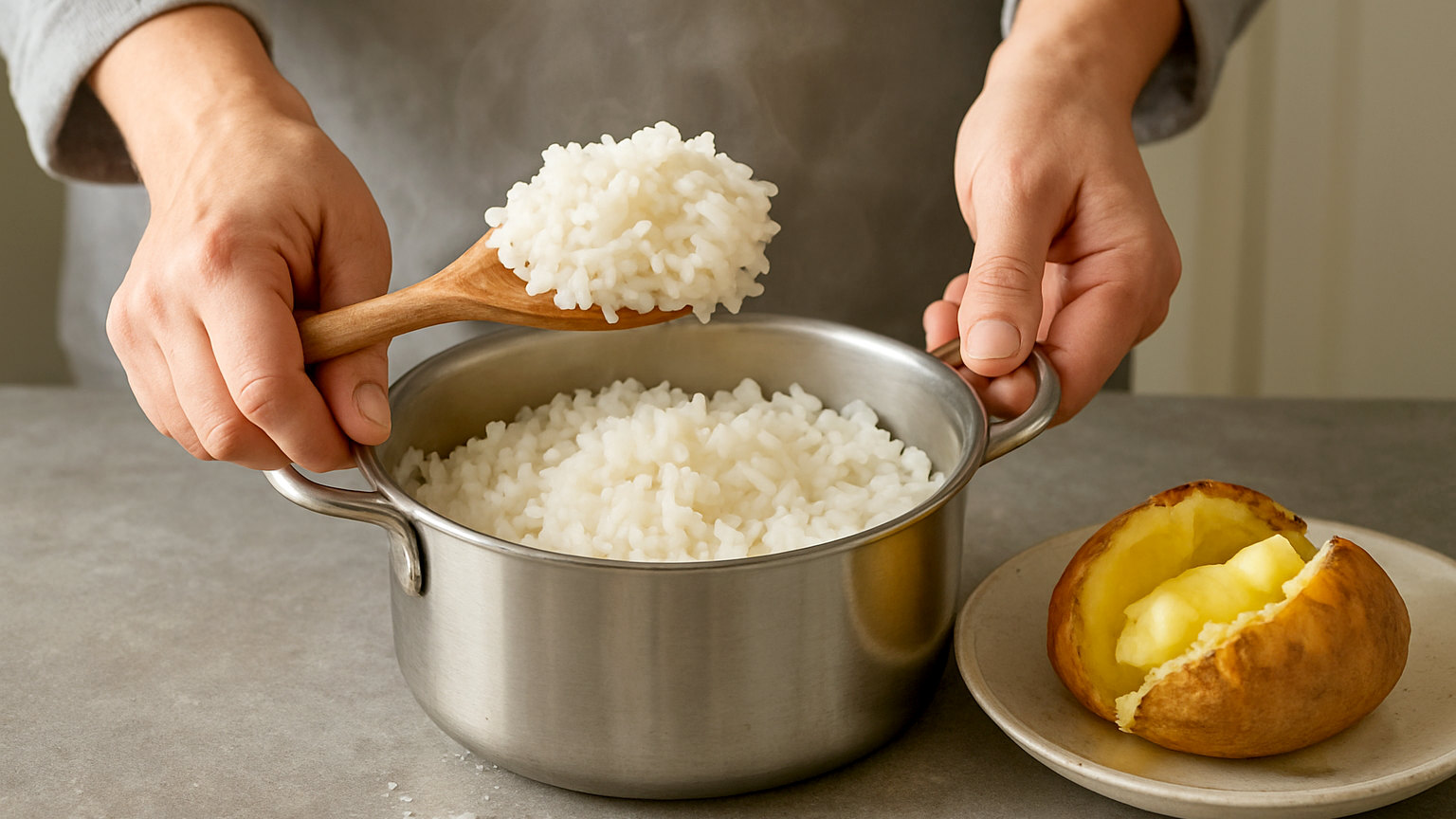
Rice is straightforward once you accept two things: it needs rinsing, and it needs to be left alone. Most sticky, claggy rice is the result of unrinsed grains and a lid that was lifted to check. The absorption method below works for basmati and long grain and needs no measuring jug beyond the pan itself.
Why rinse it?
Milling leaves loose starch on the surface of every grain, and that starch turns to glue in the pan. Rinsing removes it.
Put the rice in a bowl, cover with cold water, swirl and drain, and repeat until the water runs almost clear. Three or four changes is usually enough.
What is the ratio?
For basmati, one part rice to one and a half parts water by volume. For long grain, one to one and three quarters.
Measure by volume rather than weight, using a mug for both, which makes the arithmetic trivial.
What is the method?
- Rinse the rice until the water runs almost clear and drain well.
- Put it in a pan with the measured water and a good pinch of salt.
- Bring to the boil uncovered.
- As soon as it boils, turn the heat to the lowest setting and cover tightly.
- Cook for 10 minutes for basmati, 12 for long grain, without lifting the lid.
- Take the pan off the heat and rest for 10 minutes, still covered.
- Fork through gently to separate the grains.
The lid stays on for the resting period. That ten minutes off the heat is when the grains finish absorbing and firm up, and lifting the lid releases the steam that does it.
Should you salt the water?
Yes. It is the only chance to season the rice itself, and unsalted rice tastes noticeably flat.
About half a teaspoon per mug of dry rice.
What size pan should you use?
One where the rice sits no more than about 3cm deep, so it cooks evenly. A deep narrow pan overcooks the bottom before the top has absorbed.
A tight fitting lid matters more than the material, since escaping steam changes the ratio.
Does soaking help?
For basmati, thirty minutes of soaking gives longer, more separate grains and shortens the cooking time by a couple of minutes.
It is optional rather than necessary, and it is standard in Indian cooking.
What about brown rice?
It needs about twice as much water and 25 to 30 minutes, since the bran layer slows absorption. The resting period still applies.
It is also more forgiving, since it does not go sticky in the same way.
Can you cook it in the oven?
Yes, and it is reliable for large quantities. Use boiling water, cover the dish tightly with foil and cook at 180C fan for 25 minutes, then rest for 10.
It frees the hob completely, which is useful when the rest of the meal needs it.
Why did it stick to the pan?
The heat was too high or the pan is too thin. Use the lowest setting your hob allows and a heavy based pan with a well fitting lid.
A slightly catching base layer is normal and is not a fault.
How should leftover rice be handled?
Cool it as fast as possible, ideally within one hour, by spreading it on a tray. Refrigerate and use within one day.
Uncooked rice can contain Bacillus cereus spores that survive cooking and multiply at room temperature, which is why the cooling matters more than with other leftovers, in line with Food Standards Agency guidance.
Does a rice cooker do it better?
It is more consistent, since it manages the heat and the resting automatically, and it is worth having if you cook rice several times a week.
The pan method gives the same result once you have made it a few times.
Can it be reheated?
Once only, and it must be piping hot throughout. Rice left at room temperature for several hours should be thrown away.
Cold rice from the fridge is what egg fried rice needs, so a deliberate batch is worth cooking.
If that was useful, What to Cook When the Fridge Is Nearly Empty covers related ground, and there is plenty more in Mains recipes.


