
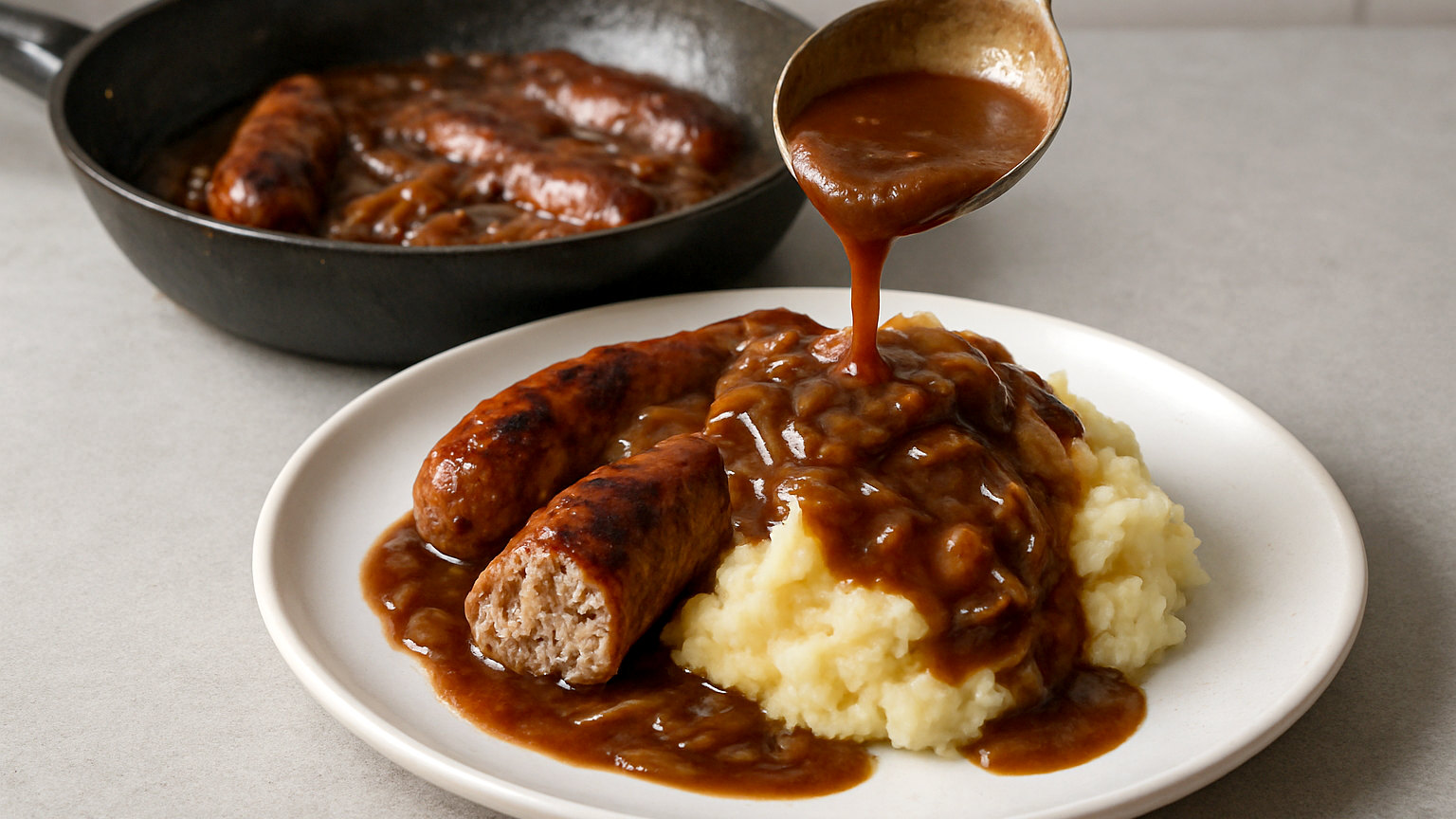
Onion gravy is the sauce that makes bangers and mash and toad in the hole worth eating, and it depends entirely on one step. The onions have to be cooked until they are genuinely brown and jammy, which takes about twenty five minutes. Every shortcut version of this recipe fails at exactly that point, and no amount of stock or seasoning afterwards makes up for it.
What do you need?
- 3 large onions, thinly sliced
- 50g butter and 1 tablespoon oil
- 1 teaspoon caster sugar
- 2 tablespoons plain flour
- 600ml beef stock
- 1 tablespoon Worcestershire sauce
- 1 teaspoon English mustard
- 2 sprigs of thyme and 1 bay leaf
- Salt and plenty of black pepper
How do you make it?
- Melt the butter with the oil in a wide pan over a medium low heat.
- Add the onions, sugar and a pinch of salt and stir to coat.
- Cook for 25 to 30 minutes, stirring every few minutes, until deep golden and sticky.
- Stir in the flour and cook for 2 minutes.
- Add the stock gradually, stirring until smooth after each addition.
- Add the Worcestershire sauce, mustard, thyme and bay.
- Simmer for 10 minutes until it coats the back of a spoon.
- Remove the herbs and season to taste.
Do not raise the heat to speed the onions up. They will burn at the edges while staying raw in the middle, and burnt onion is bitter in a way that cannot be seasoned out.
How do you know when the onions are ready?
They should have collapsed to about a third of their original volume, be deep golden brown throughout, and taste sweet rather than sharp.
If they still taste of raw onion they are not done, however brown they look at the edges.
Why butter and oil together?
Butter gives flavour and helps the browning, and the oil raises the smoke point so the butter does not burn over half an hour.
All oil works and tastes less good. All butter needs a lower heat and more attention.
Which onions are best?
Ordinary brown onions, which have enough sugar to caramelise and enough bite to stay savoury. Red onions work and turn slightly sweeter.
Slice them thinly and evenly so they cook at the same rate rather than some burning while others stay raw.
Which stock should you use?
Beef stock gives the depth this gravy wants. Chicken stock makes it lighter and is a reasonable alternative if that is what you have.
A stock cube is fine here, since the onions are providing most of the flavour. Go easy on further salt if you use one.
Can it be made without meat stock?
Yes. Use a good vegetable stock with a teaspoon of Marmite and a splash of soy sauce, which supplies the savoury depth the beef stock would have given.
Check the Worcestershire sauce too, since most brands contain anchovy.
What else can go in?
A splash of ale, red wine or port added after the flour and reduced before the stock. A teaspoon of balsamic vinegar at the end.
Keep it savoury, since the onions have already brought sweetness.
Can it be made ahead or frozen?
It keeps three days in the fridge and freezes for three months. Reheat gently with a splash of stock.
Caramelised onions alone also freeze well, so making a large batch and using them across several dishes is worth the half hour.
Why is it lumpy?
The stock went in too fast. Add it a little at a time, stirring until smooth before each further addition, and the flour disperses properly.
If it does go lumpy, a stick blender or a sieve will rescue it entirely.
What else does it go with?
Toad in the hole, liver and bacon, a plain roast chicken, or poured over chips. It is also the right gravy for a vegetarian sausage and mash.
How much should you make?
Allow 150ml per person and make more. It is the first thing to run out at almost every table.
Cool leftovers quickly, refrigerate within two hours and reheat once only until piping hot, following Food Standards Agency guidance.
Next, try Bangers and Mash With Onion Gravy, or see the rest of our Mains recipes.


