
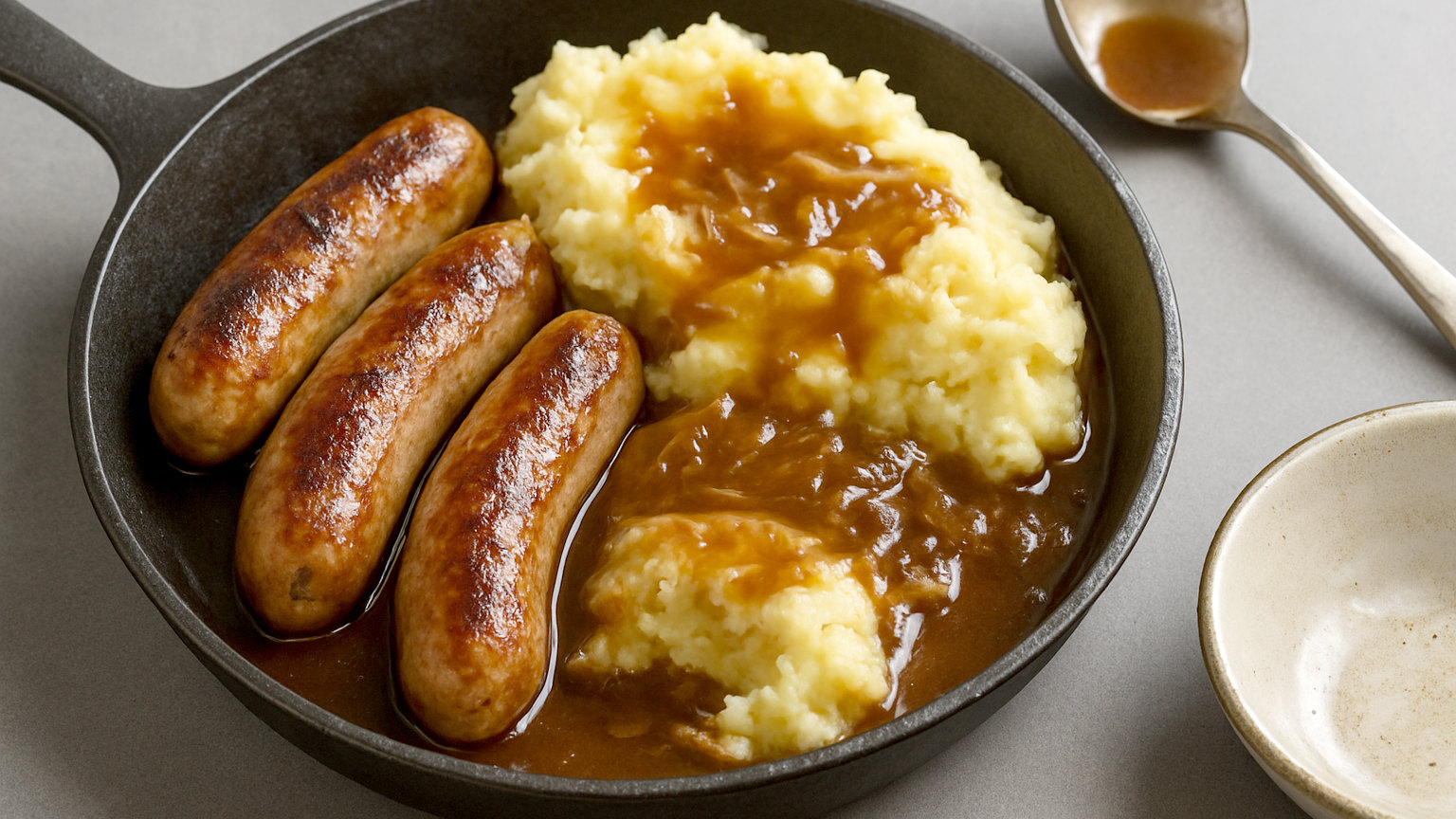
Bangers and mash is three straightforward components and it is usually let down by the gravy. Onions cooked for five minutes are still onions; onions cooked for twenty five have collapsed and caramelised into something sweet and deep that makes the whole plate. That is the only part of this dish that takes any real time, and it can be done while the sausages cook.
What do you need for 4 people?
- 8 good pork sausages
- 3 large onions, thinly sliced
- 50g butter and 1 tablespoon oil
- 1 teaspoon caster sugar
- 2 tablespoons plain flour
- 600ml beef stock
- 1 tablespoon Worcestershire sauce and 1 teaspoon English mustard
- 1kg floury potatoes, 100g butter and 100ml milk for the mash
- Salt and plenty of black pepper
How do you make it?
- Melt the butter and oil in a wide pan and add the onions with the sugar and a pinch of salt.
- Cook over a medium low heat for 25 minutes, stirring occasionally, until deep golden brown.
- Meanwhile cook the sausages in a separate pan over a medium heat for 20 minutes, turning regularly.
- Boil the potatoes for 18 minutes, drain, steam dry and rice them.
- Fold the potato through warm milk and melted butter and season well.
- Stir the flour into the onions and cook for 2 minutes.
- Add the stock gradually, then the Worcestershire sauce and mustard, and simmer for 10 minutes.
- Serve the sausages on the mash with the gravy poured over.
Give the onions the full twenty five minutes. They should be genuinely brown and jammy rather than soft and pale, and there is no way to hurry this over a high heat without burning them.
How should the sausages be cooked?
Over a moderate heat for about 20 minutes, turning every few minutes. High heat splits the skins and burns the outside before the middle is done.
They should reach 75C in the centre with no pink remaining, in line with Food Standards Agency guidance.
Why add sugar to the onions?
A teaspoon helps them caramelise and balances the salt in the stock. It is not enough to make the gravy sweet.
A splash of balsamic vinegar at the end does a similar job from the other direction.
What makes good mash for this?
Floury potatoes, riced rather than blended, with warm milk and plenty of butter. It should be soft enough to soak up gravy but firm enough to hold its shape.
Never use a food processor, which turns potato into glue in seconds.
Should the sausages go in the gravy?
Not usually. Cooking them separately keeps the skins intact and browned, and adding them to the gravy at the end softens them.
If you prefer them soft, let them sit in the finished gravy for five minutes before serving.
Can the gravy be made ahead?
Yes, and it improves. Make it up to three days ahead, or freeze it for three months, and reheat with a splash of stock.
Caramelised onions themselves freeze well, so a large batch is worth making.
What else can go in the gravy?
A splash of red wine or ale, a teaspoon of Marmite, a sprig of thyme or a bay leaf. Any of them adds depth.
Keep it savoury rather than sweet, since the onions are already providing sweetness.
Which sausages should you use?
Something with a meat content above 85 per cent. Cumberland, Lincolnshire or a plain butchers pork sausage all suit this.
Why are they called bangers?
The name comes from the First World War, when sausages contained a great deal of water and rusk and burst noisily in the pan.
Modern sausages with a decent meat content rarely bang, though very cheap ones still can if the heat is too high.
How much should you allow?
Two sausages and about 250g of potato per person, with 150ml of gravy each. Make more gravy than that, since it is always the first thing to run out.
What should you serve alongside?
Peas, buttered cabbage or green beans. Anything green cuts the richness.
Cool leftovers quickly, refrigerate within two hours and reheat once only until piping hot.
See also Proper Onion Gravy, or browse more Mains recipes.


