
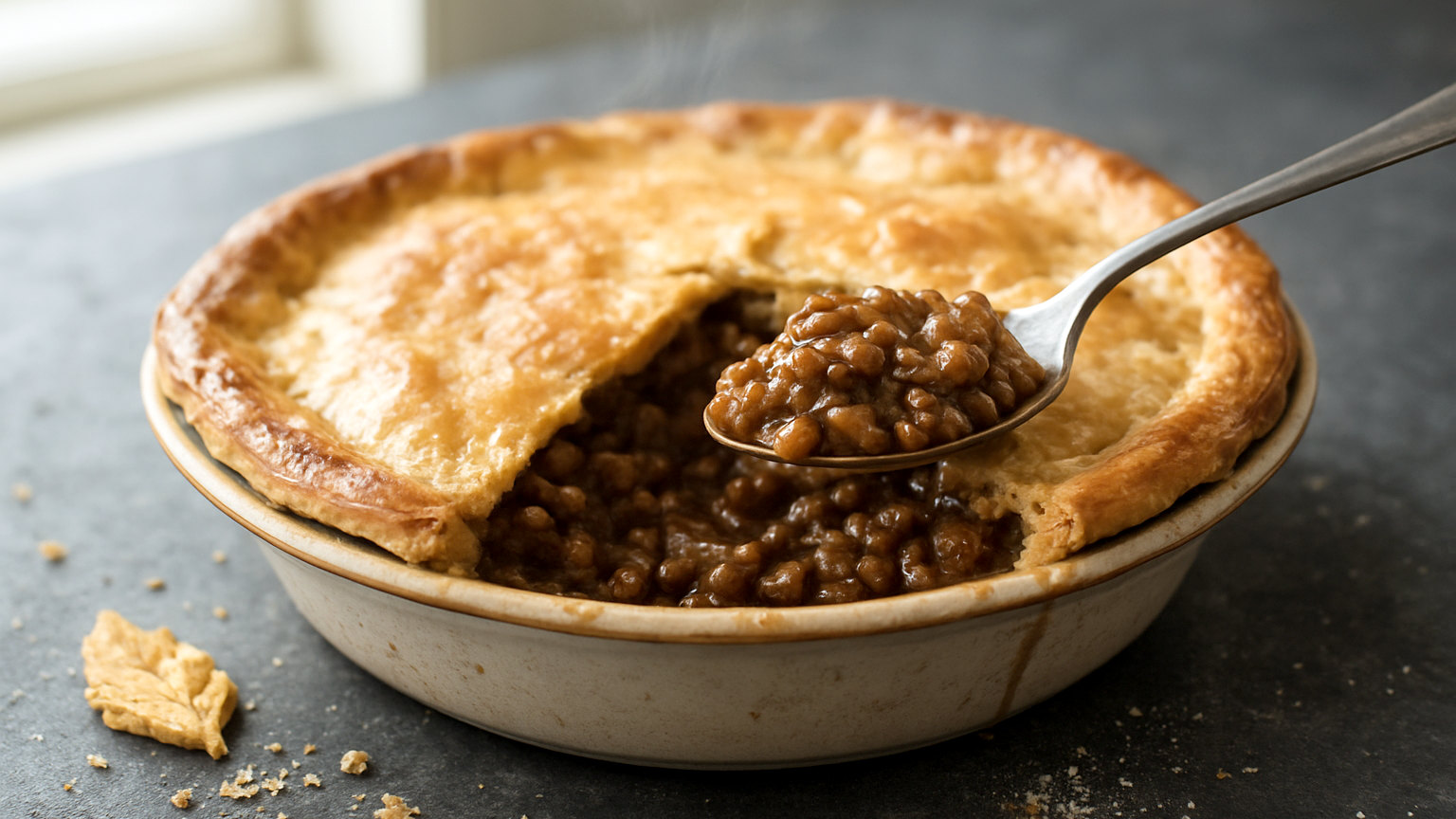
Vegetarian pies fail when they are simply a meat pie with the meat removed. What the meat was providing was savoury depth, fat and texture, and something has to replace all three. The vegetables themselves rarely manage it, which is why the successful British vegetarian pies lean on mushrooms, pulses or cheese rather than on a mixture of roots.
What is the traditional British option?
Cheese and onion pie, sold in northern chip shops and bakeries for generations. Onions cooked down slowly, strong cheese and diced potato in shortcrust.
Homity pie is the other, a wartime dish of potato, onion, leek and cheese in an open shortcrust case, associated with Devon.
How do you build savoury depth?
Brown everything hard rather than softening it. Add a spoonful of tomato puree and cook it out, then a splash of soy sauce, Marmite, miso or Worcestershire sauce.
Dried mushrooms are the most useful single ingredient. A handful of dried porcini soaked in hot water gives both an intensely savoury liquid and a meaty texture, and it costs very little.
Which mushroom filling works?
Chestnut mushrooms browned hard in batches with thyme and garlic, plus soaked dried porcini and their liquid, thickened with flour and finished with cream or a little mustard.
Cook them until the pan is completely dry before adding anything else, or the pie will flood.
Do lentils work?
Green or Puy lentils hold their shape and give a genuinely satisfying texture in a shepherds pie style dish under mash.
Red lentils collapse into a puree, which is useful as a thickener but wrong as the main component.
What about a root vegetable pie?
It works if the roots are roasted first rather than boiled, which concentrates their flavour and removes water. Add a strong cheese sauce or a mushroom gravy to bind.
Squash, celeriac and parsnip all suit this. Avoid a filling that is simply mixed vegetables in a thin sauce.
How do you handle the moisture problem?
Vegetables hold far more water than meat, and it comes out in the oven. Cook every component until the pan is dry before assembling.
Adding potato, breadcrumbs or lentils to the filling absorbs what remains.
What about a mash topped version?
Lentils with mushrooms, carrot and plenty of Worcestershire sauce under mashed potato is the most convincing vegetarian shepherds pie, and it needs no pastry at all.
Check the Worcestershire sauce, since most brands contain anchovy. Vegetarian versions are widely sold.
Is the pastry suitable?
Check it. Traditional shortcrust often uses lard, and shop bought puff pastry is sometimes made with animal fats. All butter versions are widely available.
Vegetable shortening gives a very short pastry and is a straight substitute for lard by weight.
What about the glaze?
Beaten egg for vegetarians, or milk for a softer finish. For a vegan pie, plant milk with a teaspoon of maple syrup browns reasonably well.
Can these be made vegan?
Mushroom and lentil fillings adapt easily, using oil or vegan block in the pastry and stock rather than cream. Cheese based fillings are harder to convert convincingly.
A mushroom and ale pie with rough puff made from vegan block is genuinely good rather than a compromise.
Does a vegetarian pie need less cooking?
Usually yes, since the filling is already cooked and only the pastry needs baking. Thirty minutes at 200C fan is generally enough for a lidded pie.
That makes them quicker to get on the table than a meat pie, provided the filling was made in advance.
Can they be made ahead?
The fillings keep two days in the fridge and most freeze for three months. Assembled unbaked pies freeze well and bake from frozen.
What should you serve with them?
The same things as a meat pie: mash or chips, peas or greens, and plenty of gravy. Cool leftovers quickly, refrigerate within two hours and use within two days, following Food Standards Agency guidance.
If that was useful, Hot Water Crust Pastry for Raised Pies covers related ground, and there is plenty more in Mains recipes.


