
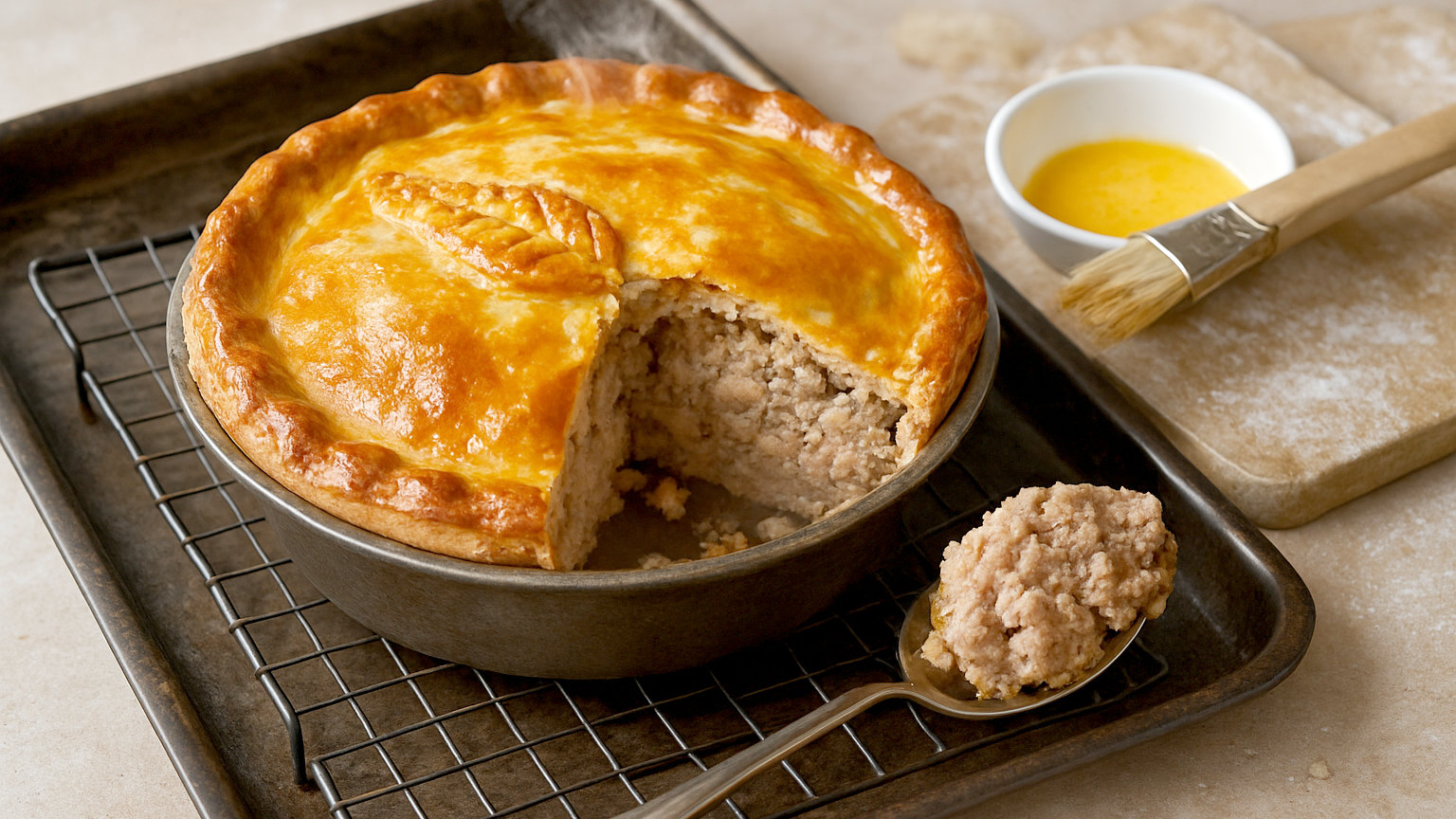
Hot water crust is unlike every other pastry, because it is made and worked warm rather than cold. Boiling water and melted lard turn the flour into a dough that is pliable like clay while hot and sets rock firm as it cools. That is what allows a pork pie to stand up without a tin and hold its shape through baking and a night in the fridge.
What do you need for a 20cm pie?
- 450g plain flour
- 1 teaspoon salt
- 150g lard
- 175ml water
- 1 egg, beaten, for glazing
How do you make it?
- Sift the flour and salt into a bowl and make a well in the centre.
- Put the lard and water in a small pan and bring to a rolling boil.
- Pour the boiling liquid into the well and mix quickly with a wooden spoon.
- As soon as it is cool enough to handle, knead briefly until smooth.
- Cut off a quarter for the lid and keep it covered and warm.
- Work the rest while still warm, pressing it up the sides of a tin or moulding it around a jar.
- Fill, add the lid, seal the edges and cut a steam hole.
- Glaze with egg and bake at 180C fan for about 1 hour 45 minutes.
Work it while it is warm. This is the opposite of every other pastry and it is not negotiable. Once hot water crust cools it becomes brittle and cracks rather than stretching.
Why lard rather than butter?
Lard has no water in it and a high melting point, which gives the pastry its firmness and its slightly waxy, sturdy texture.
Butter makes a softer, richer crust that will not hold a raised pie upright. Some recipes use a mixture, with lard doing most of the work.
How do you raise a pie by hand?
Mould the warm dough around the base of a floured jam jar, working it up the sides to an even thickness, then leave it to cool and firm before easing the jar out.
A springform tin is far easier and gives a neater result. Hand raising is traditional and takes practice.
How thick should it be?
About 5mm, which is considerably thicker than shortcrust. It is a structural pastry as much as an edible one.
Thin patches leak during baking, and a leak in a raised pie empties the jelly out and ruins it.
What goes inside?
Coarsely chopped pork shoulder with a little belly for fat, seasoned heavily with salt, pepper, mace and sage. Game, chicken and ham all work.
The filling goes in raw and cooks inside the pastry, which is why the baking time is so long.
What is the jelly for?
The meat shrinks during baking and leaves a gap. Pouring in a well flavoured stock through the steam hole once the pie has cooled fills that space and sets as jelly.
Use a stock made from pork bones and a trotter, which sets firmly without any added gelatine.
How do you know it is cooked?
The internal temperature should reach 75C, in line with Food Standards Agency guidance for pork. A digital probe pushed through the steam hole is the only reliable check.
The pastry will be deep golden and firm well before the middle is done, so colour is not a guide.
Can it be made ahead?
The pastry itself has to be used immediately while warm, so it cannot be made in advance in the way shortcrust can.
The filling can be mixed and seasoned a day ahead, and the finished pie is better after a night in the fridge, so the timing works out.
How should it be stored?
Cool completely, add the jelly, then refrigerate for at least six hours before cutting. It keeps three days in the fridge.
Raised pies are eaten cold, so this resting period is part of the recipe rather than a storage instruction.
See also Vegetarian Pies Worth Making, or browse more Mains recipes.


