
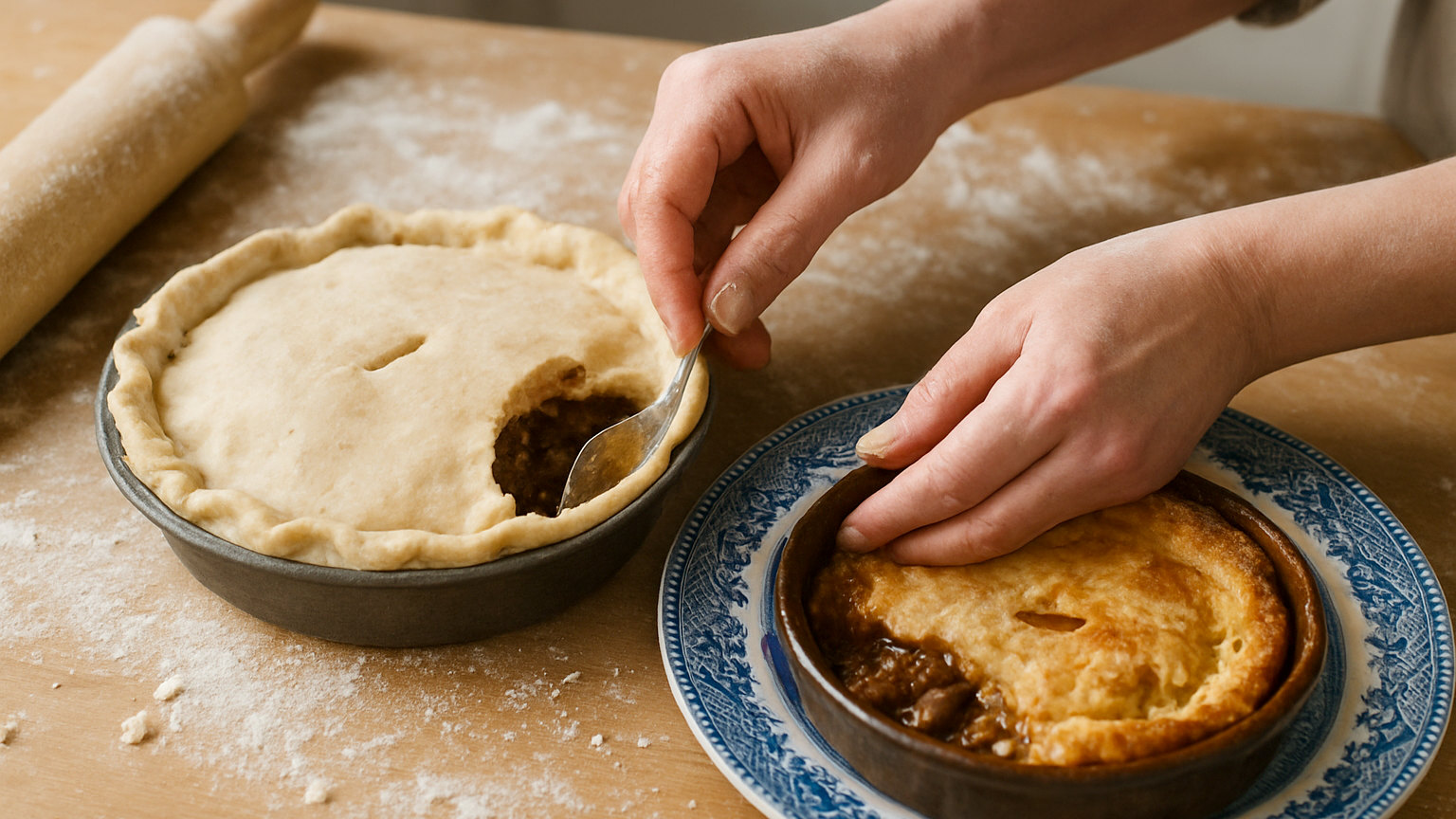
Shortcrust is the foundation of British pie making and it is genuinely easy, provided you accept that the two things it hates are heat and handling. The ratio is half fat to flour by weight, which is worth memorising because it removes the need for a recipe. Everything else is about keeping the mixture cold and touching it as little as possible.
What do you need for a 23cm pie?
- 300g plain flour
- 75g cold butter, diced
- 75g cold lard or vegetable shortening, diced
- Half a teaspoon of salt
- 4 to 6 tablespoons ice cold water
How do you make it?
- Sift the flour and salt into a large bowl.
- Add the diced fats and toss them through the flour to coat.
- Rub the fat into the flour with your fingertips, lifting high to aerate, until it resembles coarse breadcrumbs.
- Add 4 tablespoons of the water and bring it together with a knife.
- Add more water a teaspoon at a time only if there is dry flour left.
- Gather it into a ball with as little kneading as possible.
- Flatten into a disc, wrap and chill for at least 30 minutes.
Use a knife rather than your hands to bring it together. Warm hands melt the fat and the pieces you have carefully kept solid disappear into the flour, which is what makes pastry tough rather than short.
Why does everything need to be cold?
Shortness comes from small solid pieces of fat sitting in the flour. In the oven they melt and steam, leaving layers and pockets that make the pastry crumbly.
Fat that has softened and blended into the flour simply makes a dough, which bakes hard.
Butter or lard?
A mixture. Butter gives flavour and colour, lard gives shortness because it has a higher melting point and no water in it.
All butter pastry tastes better and is slightly tougher. All lard pastry is beautifully short and tastes of very little.
How much water should you add?
As little as will hold it together. Too much water develops the gluten and makes the pastry shrink and toughen in the oven.
Add it gradually and stop the moment there is no loose flour left. The dough should look slightly rough rather than smooth.
Why does it need resting?
The gluten relaxes, so the pastry shrinks less in the tin, and the fat firms up again after handling. Thirty minutes is the minimum and an hour is better.
Rest it again for twenty minutes after lining the tin, which is the step that prevents the sides sliding down during baking.
Can you make it in a food processor?
Yes, and it keeps the mixture cooler than hands do. Pulse the fat into the flour in short bursts and stop while there are still visible pieces.
Add the water with the motor off and finish by hand, since a processor will overwork the dough in seconds.
Can you make a sweet version?
Yes. Add 25g of caster sugar to the flour and use all butter rather than a mixture, which gives a sweet shortcrust for fruit pies and tarts.
An egg yolk in place of some of the water makes it richer and easier to handle, which is why most tart recipes include one.
How do you roll it out?
On a lightly floured surface, turning it a quarter turn between each roll to keep it round and stop it sticking.
Roll to about 3mm for a base and 4mm for a lid. Roll from the centre outwards rather than back and forth.
Why has the pastry shrunk?
Too much water, too much handling, or not enough resting. All three develop or tighten the gluten, which then contracts in the heat of the oven.
Resting the lined tin for twenty minutes in the fridge before baking is the most effective single fix.
Can it be made ahead?
It keeps three days in the fridge and freezes for three months, either as a disc or already rolled and lined into a tin.
Frozen lined tins can be blind baked straight from the freezer, which is genuinely useful.
Worth reading next: Rough Puff Pastry in Twenty Minutes. There is more in our Mains recipes.


