
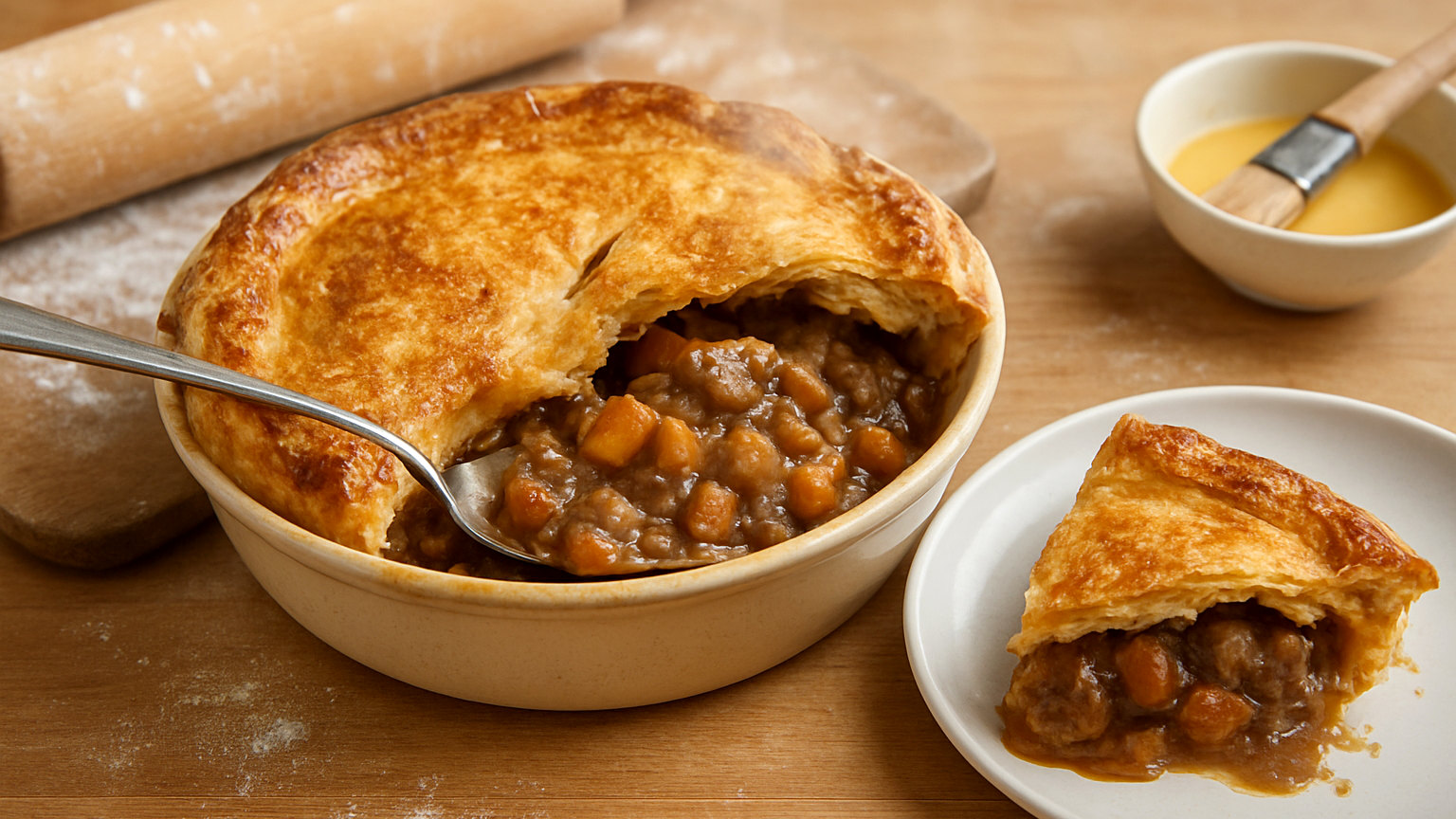
Full puff pastry involves wrapping a block of butter in dough and rolling and folding it six times with rests in between, which takes the best part of a day. Rough puff achieves most of the same effect by leaving the butter in large flat pieces from the start. It takes about twenty minutes of actual work and it is more than good enough for a pie lid.
What do you need?
- 250g plain flour
- 250g cold butter, cut into 2cm cubes
- Half a teaspoon of salt
- 150ml ice cold water
- 1 teaspoon lemon juice
How do you make it?
- Put the flour and salt in a bowl and add the butter cubes, tossing to coat.
- Do not rub the butter in. The cubes should stay whole.
- Add the water and lemon juice and bring together with a knife into a rough, lumpy dough.
- Turn onto a floured surface and shape into a rectangle.
- Roll out to about 40cm by 15cm, keeping the edges straight.
- Fold the top third down and the bottom third up, like a letter.
- Turn 90 degrees and repeat the rolling and folding four more times.
- Chill for 20 minutes after the second and fourth turns.
- Rest for 30 minutes before using.
The dough should look a mess at the start. Lumps of butter visible in the dough are the point rather than a mistake, and a smooth dough at this stage means the butter has been worked in and the pastry will not rise.
Why does it rise?
The rolling and folding flattens the butter into thin sheets separated by dough. In the oven the water in the butter turns to steam, forcing those layers apart.
Every fold roughly triples the number of layers, which is why five turns produce hundreds.
Why the lemon juice?
The acid slightly weakens the gluten, making the dough easier to roll without springing back. It is optional and the effect is modest.
White wine vinegar does the same job if there is no lemon.
What if the butter breaks through?
Flour it lightly, fold it in and put it straight in the fridge for twenty minutes. It usually means the dough has warmed up.
Work quickly and in a cool kitchen. On a hot day, chill between every turn rather than every second one.
How does it compare with full puff?
It rises perhaps eighty per cent as high and the layers are less even. On a pie lid, under gravy, nobody will notice the difference.
For a vol au vent or a mille feuille, where the pastry is the entire dish, full puff is worth the effort.
Is shop bought a fair substitute?
All butter shop bought puff is genuinely good and most cooks use it. The ones made with vegetable fat are noticeably worse and taste of the fat.
Read the ingredients rather than the price, since the two do not always correspond.
How many turns does it need?
Five is the usual number for rough puff. Fewer gives a coarser, flakier result, and more starts to blend the butter into the dough rather than layering it.
Keep count as you go, since it is surprisingly easy to lose track once the folding becomes rhythmic.
How should it be baked?
Hot, at 200C fan or above. Puff pastry needs fierce heat to turn the water in the butter to steam quickly enough to force the layers apart.
A cooler oven melts the butter out before it can lift the dough, leaving a flat greasy lid.
Should the edges be trimmed?
Trim them square between turns with a sharp knife. Rounded or squashed edges mean the layers are sealed shut at the sides and cannot rise there.
For the same reason, cut the finished pastry with a sharp downward stroke rather than dragging the knife, which pinches the layers together.
Can it be frozen?
Yes, for three months, either as a block or rolled into sheets with baking paper between them.
Defrost in the fridge overnight rather than at room temperature, so the butter stays firm.
If that was useful, Shortcrust Pastry Made by Hand covers related ground, and there is plenty more in Mains recipes.


