
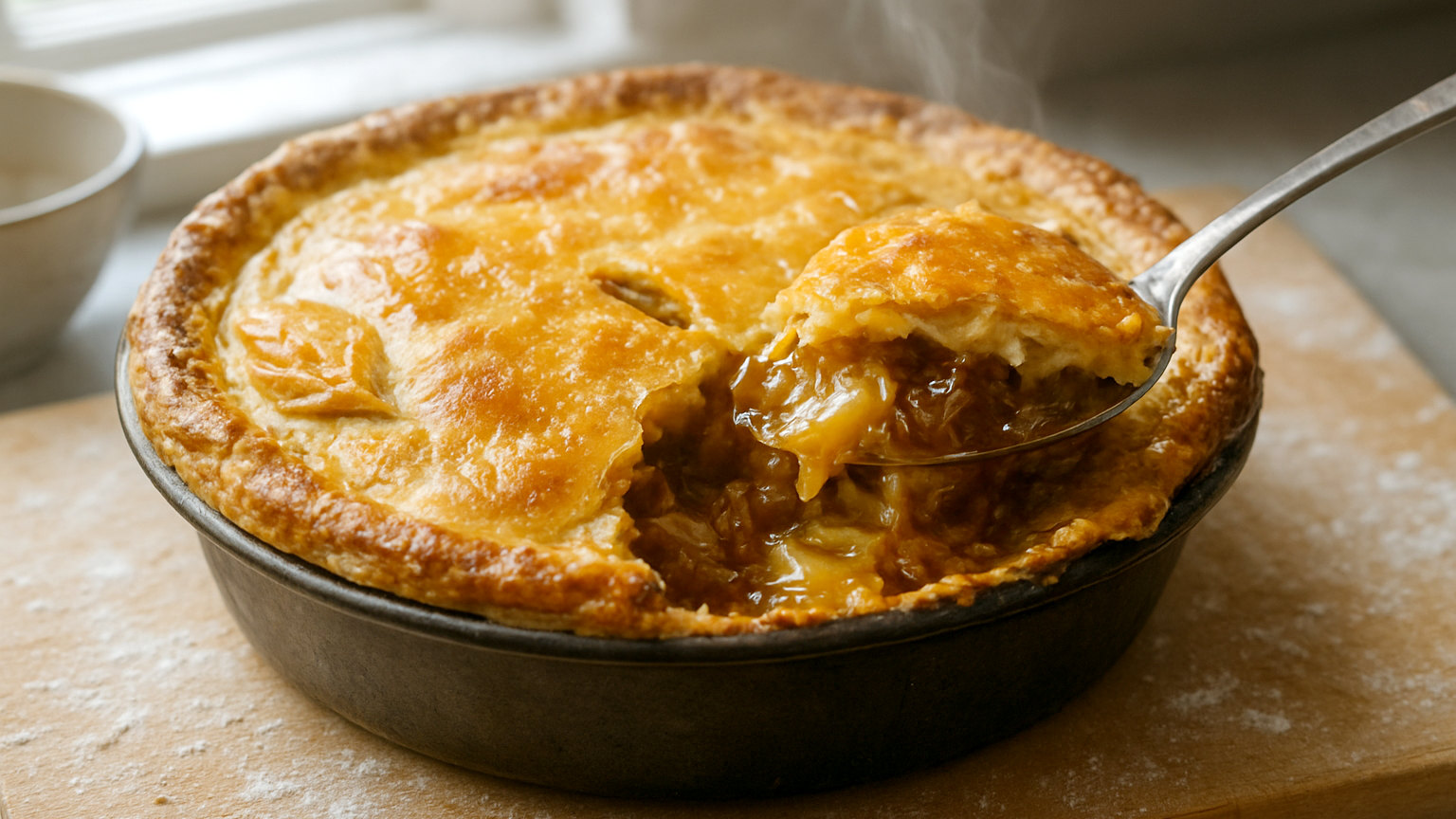
Cheese and onion pie is a northern English staple, sold in chip shops and bakeries across Lancashire and Yorkshire, and it is one of the few genuinely traditional British vegetarian main courses. Made badly it is a wet mess inside soggy pastry. The fix is to cook the onions down properly first and to add potato, which absorbs what liquid remains.
What do you need for 6 people?
- 500g shortcrust pastry, or a batch made from 300g flour
- 3 large onions, thinly sliced
- 50g butter
- 400g floury potatoes, peeled and diced small
- 300g strong cheese, coarsely grated
- 2 teaspoons English mustard
- 2 tablespoons chopped parsley
- 1 egg, beaten, for glazing
- Salt and plenty of black pepper
How do you make it?
- Melt the butter and cook the onions slowly for 25 minutes until soft, sweet and any liquid has gone.
- Boil the diced potato for 8 minutes until just tender, drain and steam dry.
- Combine the onions, potato, cheese, mustard and parsley and season heavily.
- Cool completely before assembling.
- Line a 23cm metal pie tin with two thirds of the pastry and blind bake at 190C fan for 15 minutes, then 8 minutes without beans.
- Fill, top with the remaining pastry, seal and crimp the edges.
- Cut a steam hole and glaze with beaten egg.
- Bake at 190C fan for 35 to 40 minutes until deep golden.
Cook the onions until the pan is dry. Raw or half cooked onions release their water inside the pie, and that water has nowhere to go except into the pastry underneath.
Which cheese works best?
A strong crumbly cheese. Lancashire is the traditional choice and melts beautifully. A mature or extra mature cheddar is the easy substitute.
Avoid mild cheddar, which disappears, and avoid anything very wet such as mozzarella.
Why add potato?
It bulks the filling out, absorbs moisture and stops the cheese becoming a single greasy layer. It is standard in the northern versions.
Cut it small, about 1cm, so it distributes evenly rather than forming lumps.
Does it need blind baking?
Yes. This is a fully enclosed pie with a wet filling, so the base needs setting before the filling goes in.
Brush the blind baked base with beaten egg and return it for two minutes, which seals it further.
Can it be eaten cold?
It is arguably better cold, which is how it is usually sold. The filling firms up and it slices cleanly.
That makes it excellent picnic and lunchbox food, and it is one of the few pies that travels well.
What else can go in?
Leek in place of some of the onion, a spoonful of piccalilli, chopped spring onion, or a little grated apple. Sage suits it well.
Keep additions dry, since anything wet undoes the work of cooking the onions down.
How do you crimp the edges?
Press the two layers together with your thumb, then push a finger between each thumbprint from the outside to make the traditional scalloped edge.
A fork pressed around the rim is quicker and holds just as well, which is what most bakeries actually do.
Can it be made ahead or frozen?
The filling keeps two days in the fridge. The assembled unbaked pie freezes for three months and bakes from frozen at 180C fan for about 55 minutes.
Cool baked leftovers quickly, refrigerate within two hours and use within two days, following Food Standards Agency guidance.
Why is it a northern dish?
It grew up around the Lancashire and Cheshire cheese trade and the chip shop, where a cheap filling meal without meat had an obvious market on a Friday.
It remains far more common in the north than the south, and most southern bakeries do not sell it at all.
What should you serve with it?
Baked beans and chips in the chip shop tradition, or a sharp salad and pickled beetroot if it is being eaten cold.
See also Cottage Pie and Shepherds Pie: What Is the Difference?, or browse more Mains recipes.


