
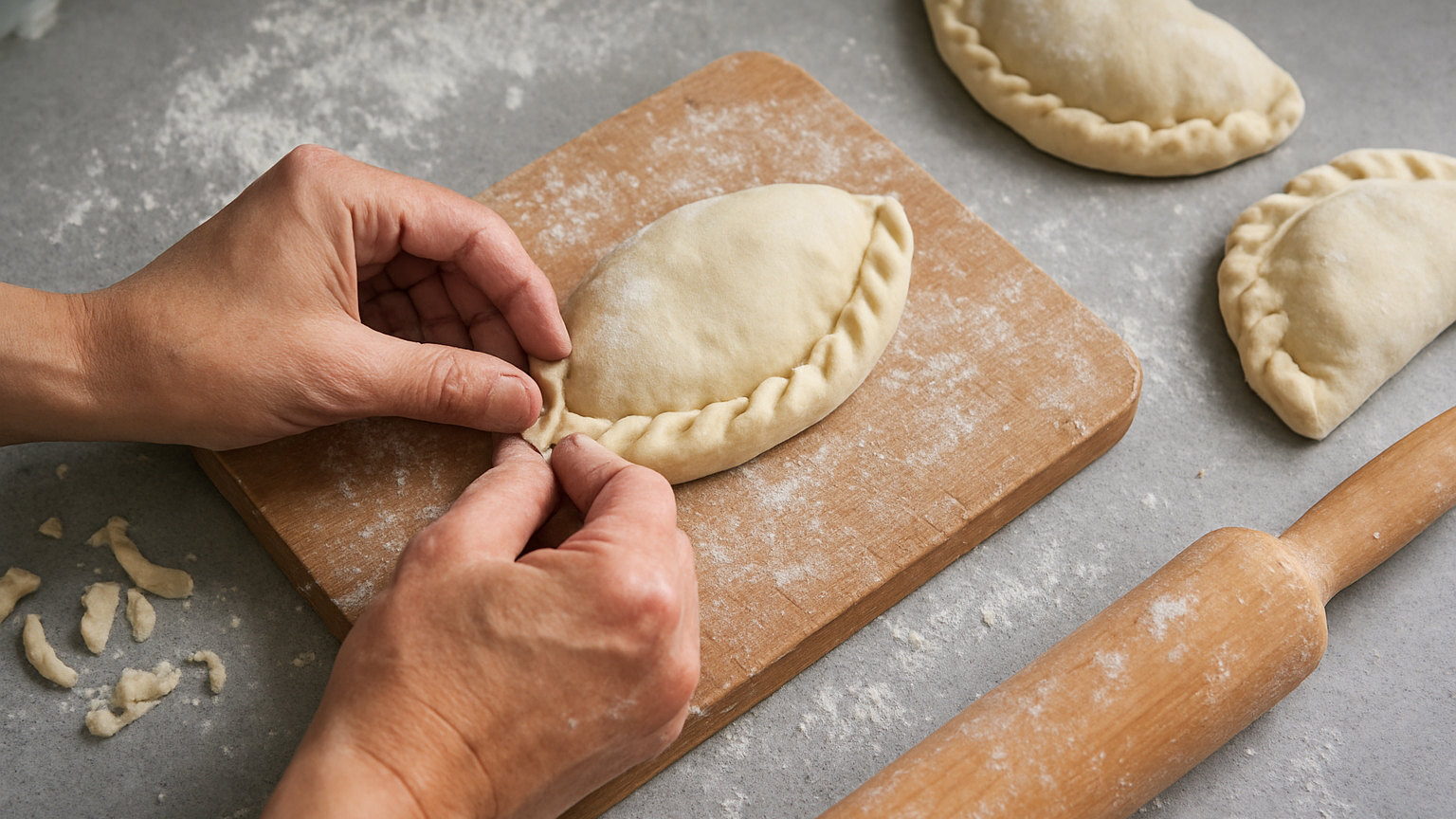
Pasty pastry is not the same as pie pastry and the difference matters. A pie sits in a dish and is eaten with a fork, so it can afford to be crumbly. A pasty has to hold a heavy wet filling for nearly an hour, then be picked up and eaten in the hand. That requires gluten, which is why strong bread flour is used rather than plain.
What do you need for 4 pasties?
- 500g strong white bread flour
- 125g lard, cold and diced
- 125g butter, cold and diced
- 1 teaspoon salt
- About 175ml cold water
How do you make it?
- Sift the flour and salt into a large bowl.
- Add the diced fats and rub them in with your fingertips until it resembles coarse breadcrumbs.
- Add most of the water and bring it together with a knife.
- Add the remaining water only if there is dry flour left.
- Knead briefly, for about thirty seconds, which is deliberate here.
- Wrap and chill for at least an hour, or overnight.
- Roll to about 4mm, slightly thinner at the edges.
Knead this pastry briefly, unlike shortcrust. You want a little gluten development for strength, which is the opposite of the usual advice, though thirty seconds is enough and more will make it tough.
Why strong flour?
It contains more protein, around 12 to 14 per cent against 9 or 10 in plain flour, so it develops more gluten and produces a stronger, more elastic pastry.
That elasticity is what lets the pastry stretch around a bulky filling without splitting.
Why lard?
Lard has a higher melting point than butter and contains no water, so it gives a sturdier pastry that holds its shape.
A half and half mixture with butter gives the structure of lard and the flavour of butter, which is the usual compromise.
Can you use all butter?
Yes, and it tastes better and is slightly more fragile. Many bakeries use all butter now.
Vegetable shortening is a straight substitute for lard by weight if you want a vegetarian pastry.
What is the ratio?
Half fat to flour by weight, so 250g of fat to 500g of flour. That is the same ratio as shortcrust, and the flour type is what changes.
Water is roughly a third of the flour weight, added gradually.
Why does it need resting?
The gluten you have just developed needs to relax, or the pastry will shrink and spring back as you roll it.
An hour is the minimum and overnight is noticeably better, which also splits the work across two days.
How thick should it be rolled?
About 4mm, which is thicker than pie pastry. Any thinner and it will not survive the weight of the filling.
Roll the edges slightly thinner so the crimp does not end up doughy.
Does it need to be blind baked?
No, and it cannot be. The pasty is sealed and the filling cooks inside it, so the pastry bakes with the filling from the start.
That is why the base does not go soggy in the way a pie base does, since there is no dish trapping moisture underneath.
Can it be made ahead or frozen?
It keeps three days in the fridge and freezes for three months, either as a block or rolled into discs with paper between them.
Defrost in the fridge overnight rather than at room temperature.
Why is it not flaky?
It is not meant to be. A flaky pastry shatters when picked up and cannot hold a wet filling, which is the opposite of what a pasty needs.
The texture should be firm and slightly chewy, closer to a bread dough than a biscuit.
How much does this quantity make?
Four large pasties or six smaller ones. It scales cleanly, and a double batch is worth making since the pastry freezes well.
Does it work for other things?
It suits any hand held pie, including bridies, clangers and sausage rolls where you want sturdiness rather than flakiness.
It is too tough for a tart case or a quiche, where ordinary shortcrust is correct.
For something along the same lines, see How to Crimp a Pasty, or browse all our Mains recipes.


