
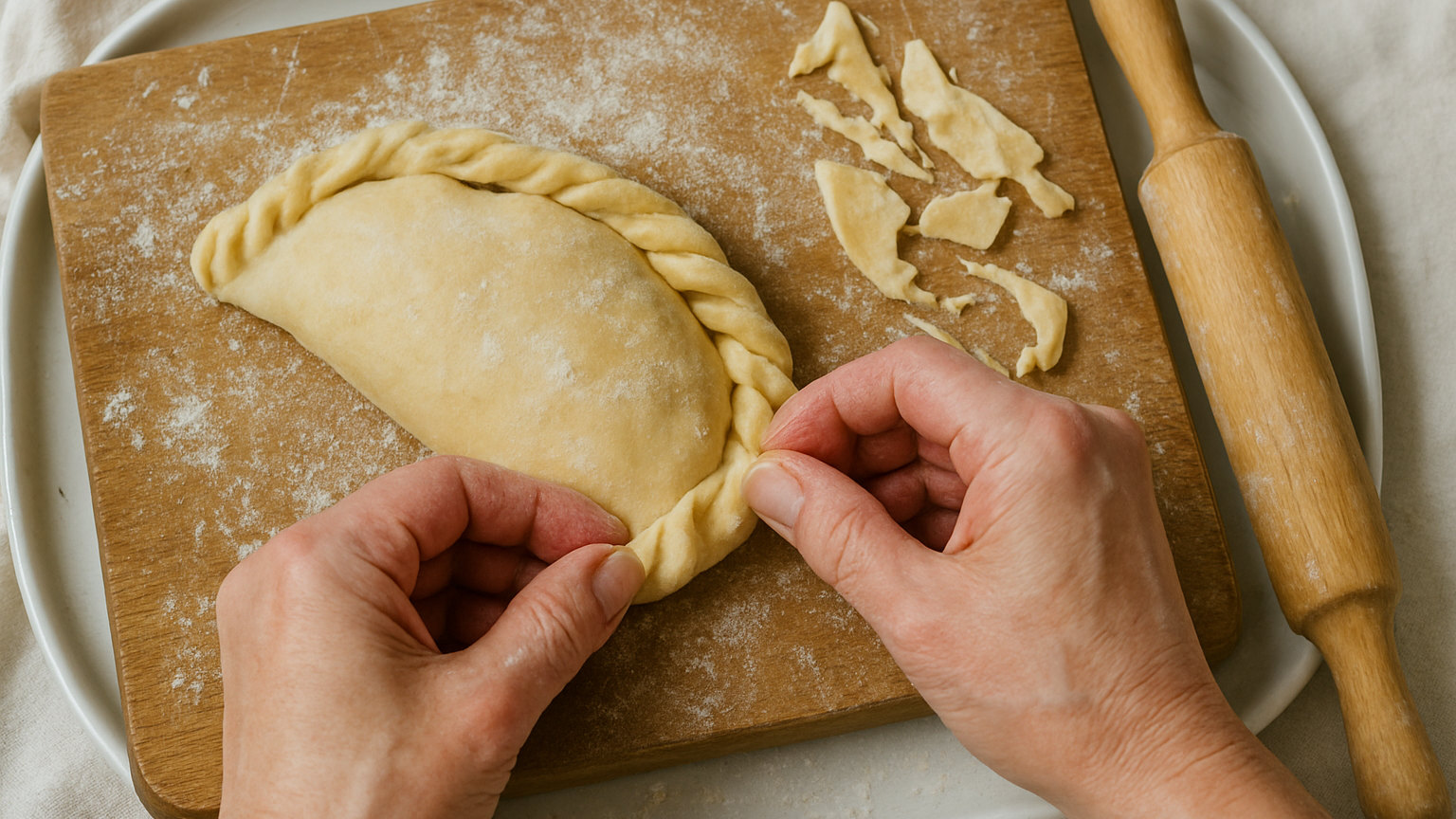
Crimping is the part of pasty making that looks like a flourish and is actually structural. The filling releases steam and liquid for the best part of an hour, and a weak seal will open under that pressure and empty itself onto the tray. A proper crimp is a rope of folded pastry that is considerably stronger than a pressed edge.
What does the crimp do?
It seals the two edges of pastry together with a series of overlapping folds, each one locking the previous one in place.
It also creates a thick handle at the edge, which is what miners were said to hold the pasty by.
How do you do the Cornish crimp?
- Fill one half of the pastry circle, leaving a 2cm border.
- Brush the border lightly with water rather than egg, which is slippery.
- Fold the empty half over and press the edges together firmly to expel any air.
- Starting at one end, fold the corner of the edge over onto itself at an angle.
- Press it down with your thumb.
- Take the next section of edge and fold it over the top of the first, pressing again.
- Continue along the whole curved edge, each fold overlapping the last.
- Tuck the final fold underneath to finish.
Press out all the air before you start crimping. Trapped air expands in the oven and will force the seal open at the weakest point, which is usually where you began.
Why water rather than egg?
Egg is slippery and makes the folds slide apart as you work. Water dampens the pastry just enough for it to bond to itself.
Egg goes on the outside afterwards, for colour and shine.
How thick should the edge be?
Roll the pastry slightly thinner at the edges than in the middle, so the folded crimp is not enormously thicker than the rest.
A very thick crimp does not bake through and stays doughy in the centre.
Is a fork crimp acceptable?
It works and it is much easier, and most home bakers use it. It seals less securely than a hand crimp and is more likely to open.
If you use a fork, press firmly and go round twice, slightly offset.
Why does the crimp open in the oven?
Trapped air, a dry edge, overfilling, or folds that were not pressed firmly. Any of the four is enough on its own.
A steam hole in the top also helps by giving pressure somewhere else to go.
Should the crimp be on the side or the top?
On the curved side for a Cornish pasty, which is part of its protected specification. Across the top is the Devon style.
Structurally both work, and the side crimp is slightly stronger because the seam is not directly above the filling.
Can you crimp with a machine?
Commercial bakeries do, and the result is uniform but shallower than a hand crimp. Hand crimped pasties are usually sold as such because it is a mark of quality.
How do you get better at it?
Practice on a batch of scraps rather than on the real thing. The movement becomes automatic after about twenty crimps and is difficult to describe usefully in writing.
Work with well chilled pastry, since warm dough tears and will not hold a fold.
Should the pastry be cold?
Yes. Warm pastry is soft and tears as you fold it, and the fat begins to melt out, which weakens the seal.
If it becomes difficult partway through, put everything back in the fridge for twenty minutes and start again.
How long does it take?
About a minute per pasty once you are used to it, and considerably longer the first few times.
Making a batch of six is a better way to learn than making one, since the movement only becomes automatic with repetition.
Does it matter if it looks untidy?
Not at all, provided it is sealed. A slightly rough hand crimp holds far better than a neat but shallow one.
Function first, appearance second, which is true of most traditional food.
Next, try Pasty Pastry: Why Strong Flour and Lard, or see the rest of our Mains recipes.


