
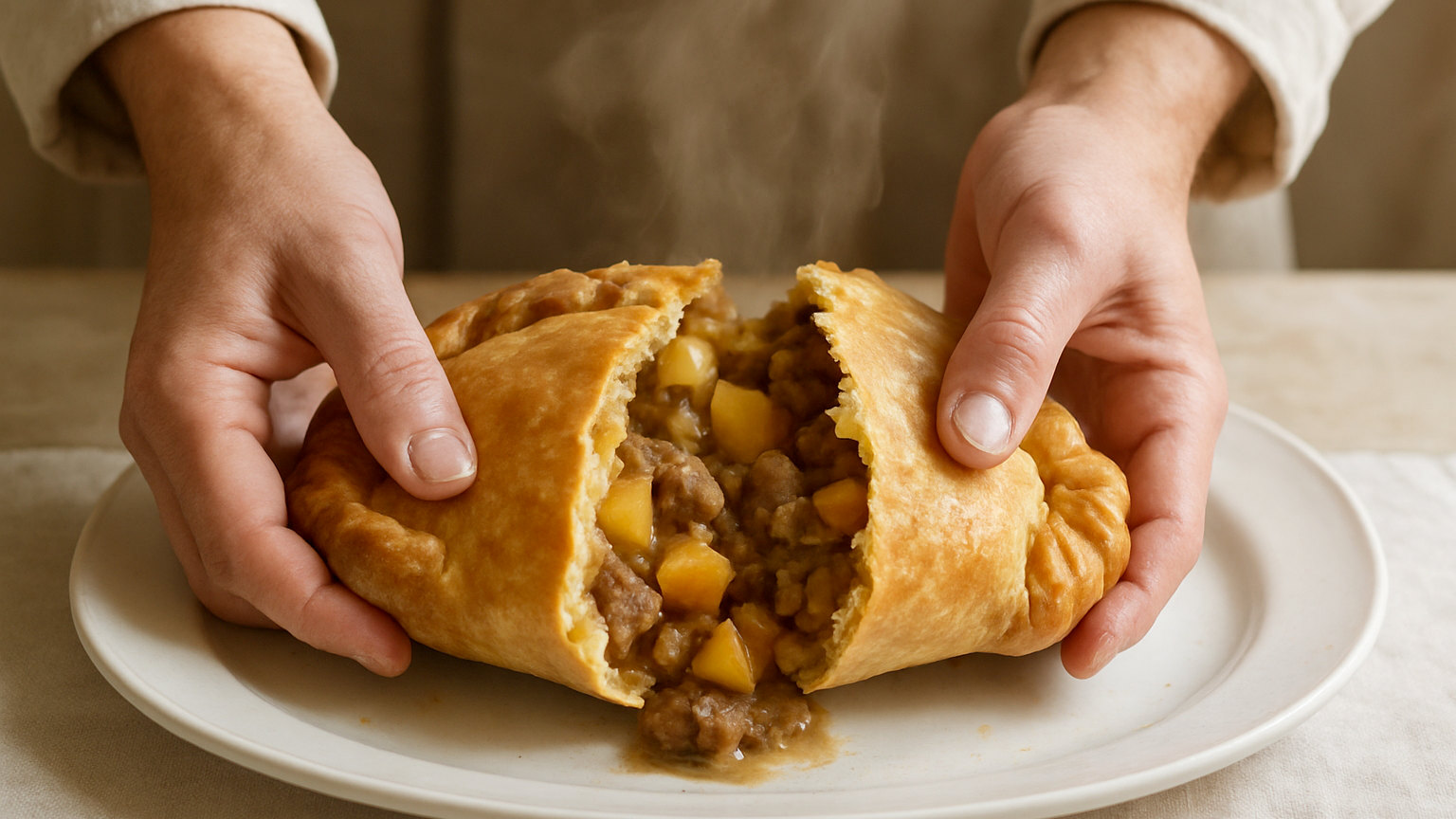
A Cornish pasty is a complete meal wrapped in pastry strong enough to be carried in a pocket, and every part of the recipe follows from that purpose. The filling goes in raw and cooks in its own steam, the pastry is made with strong flour so it does not shatter, and the whole thing is baked slowly enough for the beef and swede to become tender.
What do you need for 4 pasties?
- 500g strong white bread flour
- 125g lard and 125g cold butter, or 250g lard
- 1 teaspoon salt and about 175ml cold water
- 350g beef skirt, cut into 1cm dice
- 350g potato, peeled and thinly sliced
- 200g swede, peeled and diced small
- 1 large onion, finely chopped
- A generous amount of salt and coarse black pepper
- A knob of butter for each pasty and 1 beaten egg
How do you make them?
- Rub the fats into the flour and salt until it resembles breadcrumbs, then bring together with cold water into a firm dough.
- Wrap and chill for at least an hour, or overnight.
- Divide into 4 and roll each into a circle about 20cm across.
- Layer the potato, swede, onion and beef on one half, seasoning heavily between each layer.
- Add a knob of butter on top of the filling.
- Brush the edge with water, fold over and crimp along the curved side.
- Glaze with beaten egg and cut a small steam hole.
- Bake at 180C fan for 50 to 55 minutes until deep golden.
Season far more heavily than feels right. The filling is raw potato, swede and onion, all of which need a great deal of salt, and it is impossible to correct once the pasty is sealed.
Why does the filling go in raw?
It steams inside the sealed pastry, which is what creates the gravy. Pre cooked filling releases nothing and produces a dry pasty.
It is also the reason the bake takes nearly an hour rather than the thirty minutes a cooked filling would need.
Which cut of beef?
Skirt, which is the traditional choice and the correct one. It has enough fat and connective tissue to become tender in the time and it produces gravy.
Chuck works. Lean cuts such as rump are wrong here and will be dry and stringy.
Why swede rather than turnip?
Swede is what the recipe requires, though in Cornwall it is often called turnip, which causes endless confusion. Look for the large yellow fleshed root.
Dice it small, since it takes longer to cook than the potato.
Why strong flour?
It has more gluten, so the pastry is sturdier and less likely to crack or leak. A shortcrust made with plain flour is too fragile for a filling this heavy.
The result is chewier than an ordinary pie crust, which is correct.
Where does the crimp go?
Along the curved side, never across the top. That is the traditional Cornish form and it is part of the protected specification.
The crimp is a seal rather than decoration, so it needs to be firm and even.
Can they be made ahead or frozen?
Assemble them and freeze raw for three months, then bake from frozen at 170C fan for about 70 minutes.
They also keep two days baked in the fridge and reheat well in the oven.
Why bake them slowly?
The filling is raw and needs the best part of an hour to cook through. A hotter oven browns the pastry long before the swede and beef are tender.
If the pastry is colouring too fast, cover it loosely with foil and carry on.
How big should they be?
A 20cm circle of pastry makes a substantial pasty that feeds one person as a full meal. Smaller ones at 15cm suit a lunchbox or a picnic.
Keep the filling to about 250g per pasty, since overfilling forces the crimp open.
How do you know they are cooked?
The pastry should be deep golden and a skewer pushed through the steam hole should meet no resistance from the swede.
Cool leftovers quickly, refrigerate within two hours and use within two days, in line with Food Standards Agency guidance.
If that was useful, What Makes a Cornish Pasty Cornish? covers related ground, and there is plenty more in Mains recipes.


