
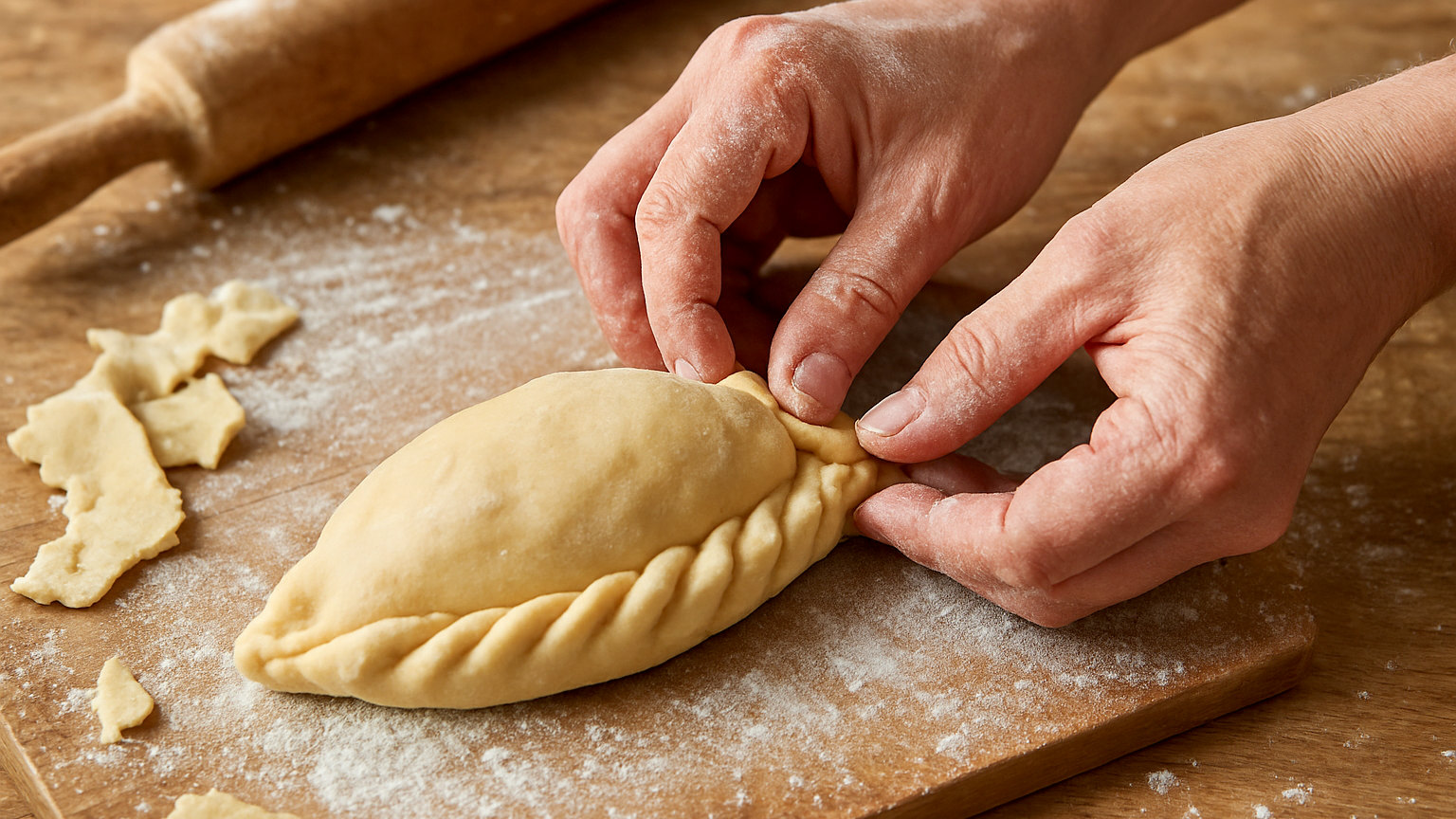
The Cornish pasty is the best known British hand pie but it is far from the only one. Nearly every region with heavy industry or long working days developed its own portable meal in pastry, and several are still made commercially. They differ in pastry, filling and shape, and the differences usually reflect what was locally available.
What is a Forfar bridie?
A Scottish hand pie from Angus, filled with minced or chopped beef, onion and suet, seasoned simply and enclosed in a horseshoe shaped pastry case.
A bridie contains no potato. That is the main difference from a Cornish pasty, and it makes the filling considerably richer and more concentrated.
What is a Bedfordshire clanger?
A long suet pastry roll with a savoury filling at one end and a sweet one at the other, usually meat and vegetables at one end and apple or jam at the other.
It was a complete meal for a farm worker, with a mark or a pastry line dividing the two halves so you knew which end to start.
What is a Scotch pie?
A small round double crust pie made with hot water crust, traditionally filled with minced mutton and heavily peppered, with a lid set below the rim.
The sunken lid was designed to hold gravy, beans or mashed potato, and it is still sold at Scottish football grounds.
What is a Welsh oggie?
A large pasty associated with the south Wales mining valleys, filled with lamb, leek and potato rather than beef and swede.
The name is shared with an old Cornish word for pasty, and the two traditions are related.
What about the Melton Mowbray pork pie?
Not strictly a hand pie for eating on the move, but it holds protected status and is hand raised without a tin, which gives it its characteristic bowed sides.
It is made with uncured pork, which is why the meat is grey rather than pink inside.
Are there others worth knowing?
The Cumberland pasty, Lancashire butter pie made with potato and onion for meat free Fridays, and the Wiltshire lardy hand pies.
Most of these survive locally rather than nationally, which is part of what makes them worth seeking out.
What is a Lancashire butter pie?
A potato and onion pie with butter and no meat at all, developed for Catholic households in the north west who did not eat meat on Fridays.
It is sometimes called a Friday pie or a Catholic pie, and it is still sold in bakeries around Preston and Chorley.
Why did so many regions develop one?
Because they solved the same problem. Miners, farm workers and mill hands all needed a hot meal that could be carried, held in dirty hands and eaten without a plate or cutlery.
Pastry was the cheapest way to achieve all three, and the local filling followed whatever was farmed or reared nearby.
What do they have in common?
A sturdy pastry, a filling substantial enough to be a meal, and a shape that can be carried and eaten without a plate.
Almost all of them were working food rather than restaurant food, which is why they are cheap and filling.
Which pastry do they use?
Strong flour shortcrust for pasties and bridies, suet pastry for clangers, and hot water crust for Scotch and pork pies.
All three are sturdier than an ordinary pie crust, for the same reason.
Are any of them protected?
The Cornish pasty and the Melton Mowbray pork pie both hold protected status. Bridies, clangers and oggies do not, so anyone can make and sell them under those names.
Can you make them at home?
All of them, and the pasty pastry in this section works for bridies and oggies without modification. Clangers need suet pastry and Scotch pies need hot water crust.
Cool any baked hand pie quickly, refrigerate within two hours and use within two days, in line with Food Standards Agency guidance.
For something along the same lines, see Can You Freeze Pasties?, or browse all our Mains recipes.


