
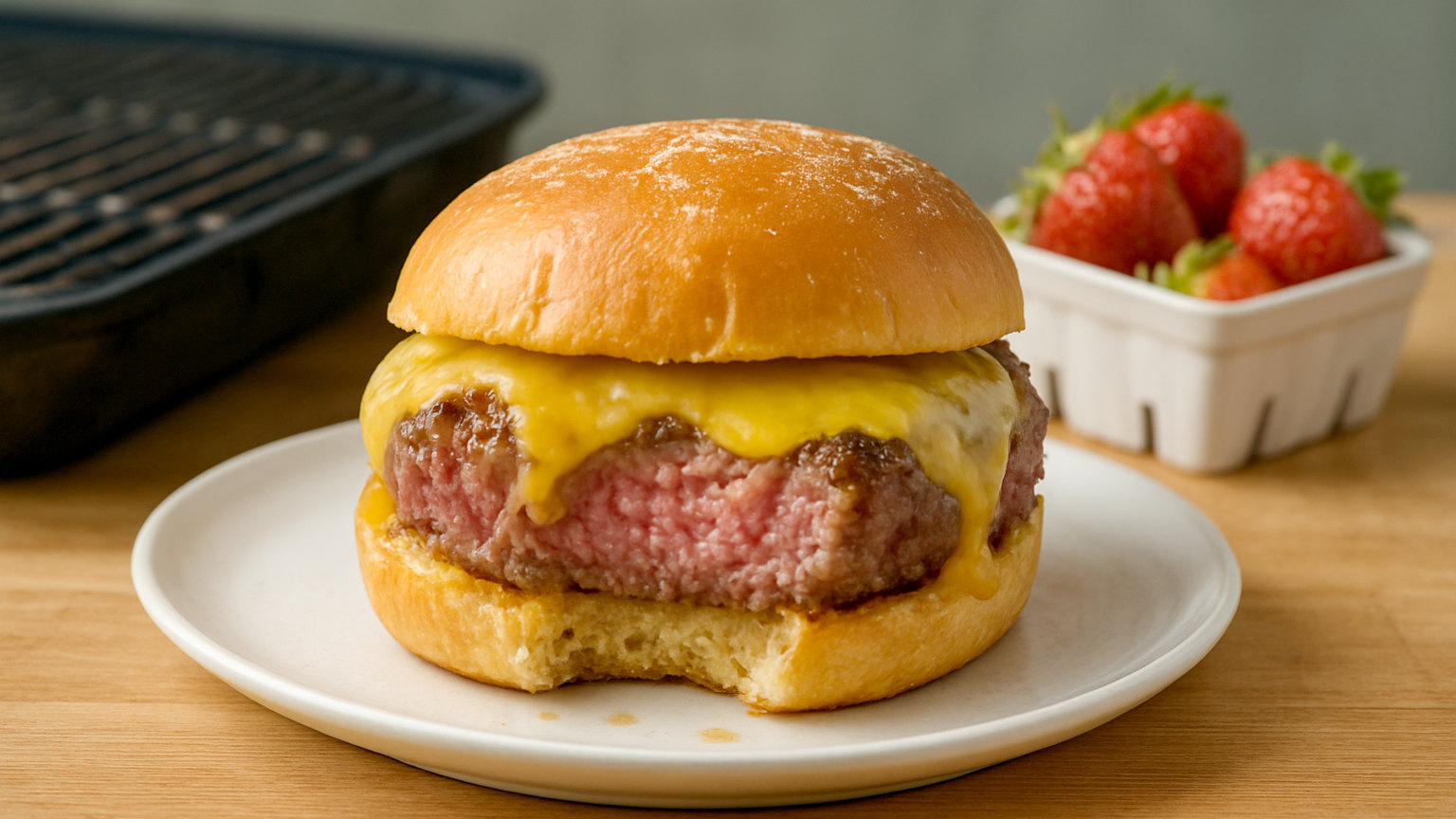
A homemade burger is better than almost anything bought, and it needs four things: coarsely minced beef with enough fat, minimal handling, salt applied only to the outside, and a genuinely hot surface. Everything people usually add, from egg to breadcrumbs to onion, makes it worse rather than better.
What do you need for 4 burgers?
- 600g coarsely minced beef chuck or brisket, about 20 per cent fat
- Flaky salt and coarsely ground black pepper
- A little oil
- 4 soft buns or barm cakes
- Cheese, lettuce, tomato, red onion and pickles to serve
How do you make them?
- Divide the mince into 4 loose balls of about 150g without compacting it.
- Flatten each gently into a patty slightly wider than the bun.
- Press a shallow dimple into the centre of each with your thumb.
- Chill for 30 minutes.
- Season both sides generously with salt and pepper just before cooking.
- Cook on a very hot grill or pan for 3 to 4 minutes without moving them.
- Turn once and cook for 3 to 4 minutes more, adding cheese for the last minute.
- Check the centre reaches 75C, then rest for 3 minutes.
Salt the outside only, and only just before cooking. Salt mixed into the mince dissolves the proteins and gives a springy, sausage like texture rather than a loose, tender burger.
What fat content do you need?
About 20 per cent. Anything leaner gives a dry burger whatever else is done to it.
Chuck, brisket and short rib all have roughly the right ratio.
Why not add egg or breadcrumbs?
Those are for meatballs and rissoles, which need binding. A burger holds together on the fat and protein alone if handled lightly.
Additions make the texture dense.
How do you know when to turn it?
When it releases from the grill without sticking, usually three or four minutes. Forcing it early tears the crust off.
What is the dimple for?
Burgers swell in the middle as they cook. A shallow dimple counteracts it so the finished patty is flat rather than domed.
Why must burgers be cooked through?
Mincing spreads any surface bacteria throughout the meat, so unlike a steak the centre must reach 75C with no pink and clear juices, in line with Food Standards Agency guidance.
A probe thermometer is the only reliable check.
How much mince per burger?
About 150g each, which gives a substantial patty. Two smaller 75g patties in one bun is the other good option.
Why chill them first?
Cold patties hold their shape on the grill and the fat renders more slowly, keeping them juicier.
Can lamb or pork mince be used?
Both work with the same method and the same 75C rule. Lamb suits mint and cumin, pork suits apple and sage.
Should they be pressed down?
Never. Pressing squeezes out the fat and juices, which is exactly what you are trying to keep in.
Should cheese go on the burger?
Add it for the last minute with the lid down, which melts it without overcooking the meat. Cheddar and American style slices both work.
Which bun works best?
A soft bun that yields easily, lightly toasted on the cut side. A crusty roll fights the burger.
How should they be built?
Sauce on the base, then lettuce as a barrier, then the burger, cheese, onion and pickles.
How thick should the patty be?
About 2cm and slightly wider than the bun, since burgers shrink in width as they cook.
A thin patty cooks through before it browns and a thick one burns outside.
Should the mince be coarse or fine?
Coarse, through a large plate. Fine mince packs together and gives a dense texture closer to a meatloaf.
A butcher will mince a chuck steak coarsely if you ask.
How long do they keep?
Raw patties keep a day refrigerated or three months frozen, layered with paper.
Keep raw mince below 5C and separate from cooked food.
If that was useful, How to Pack a Proper Picnic covers related ground, and there is plenty more in Seasonal recipes.