
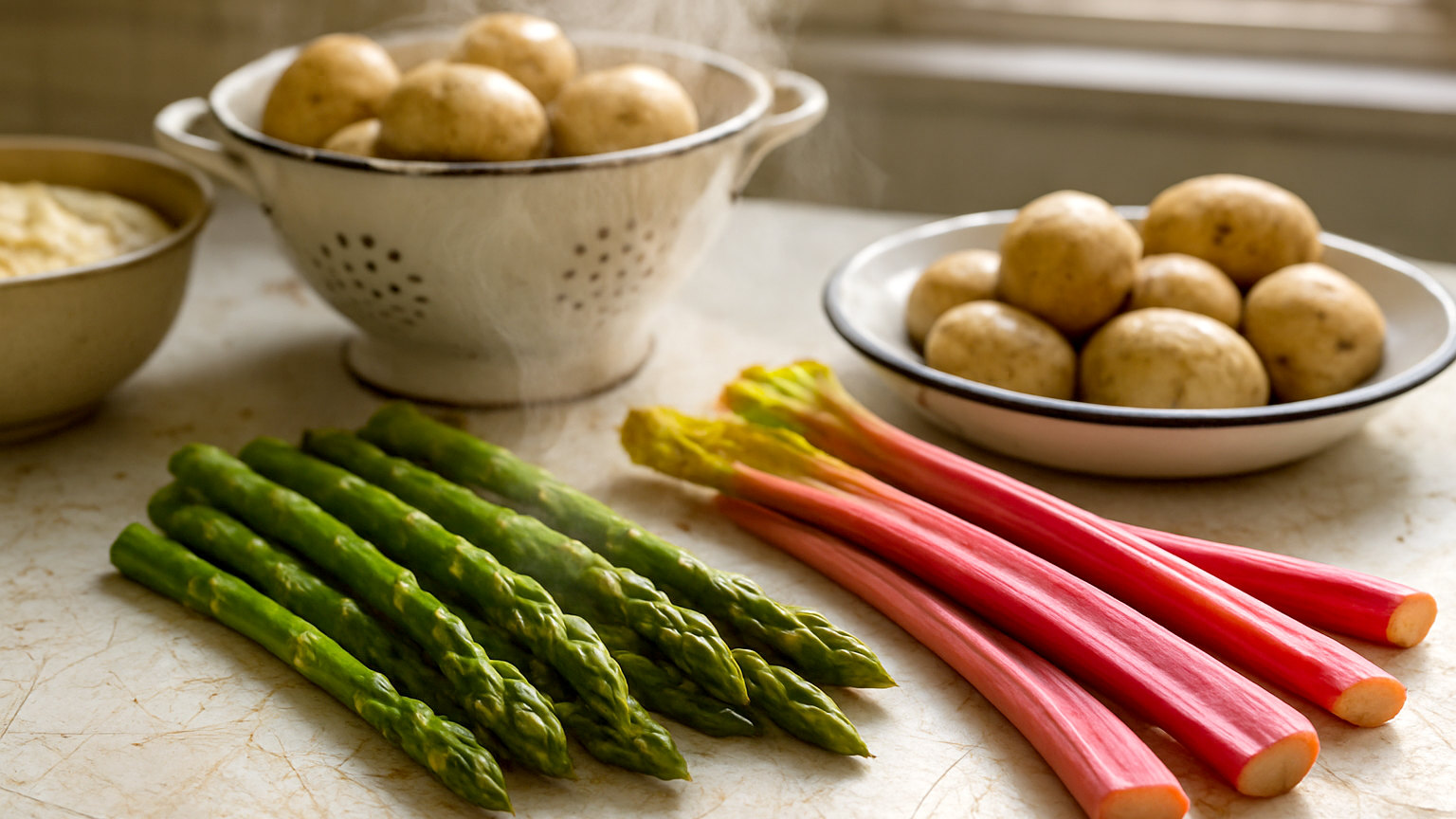
St George's Day falls on 23 April and is the national day of England, marked far more quietly than St Patrick's Day or St David's Day. It has one useful piece of timing on its side: it is traditionally the start of the English asparagus season, which gives anyone cooking for it an obvious place to begin.
Which other countries claim him?
Georgia, Portugal, Catalonia, Ethiopia and several others, along with a number of cities. He is one of the most widely adopted saints in Christendom.
Who was St George?
A Roman soldier, probably from Cappadocia in modern Turkey, martyred in the early fourth century. He never visited England.
He became patron saint of England in the fourteenth century, having earlier been adopted as a soldiers saint by crusaders.
What is in season on 23 April?
- English asparagus, traditionally from this exact date
- Jersey Royals and other early potatoes
- Wild garlic at its peak
- Purple sprouting broccoli, at the end of its run
- Spring greens, radishes and watercress
- New season lamb
- Field rhubarb
Why is asparagus associated with it?
The English asparagus season traditionally opens on St George's Day and closes at the summer solstice. The dates are approximate and growers and buyers still work to them.
It is a genuinely useful coincidence for anyone planning a meal.
What should you cook?
Asparagus with butter or hollandaise to start, roast lamb or a raised pie for the main, and rhubarb with custard to finish.
Cheese and biscuits with an English cheese is a reasonable alternative pudding.
Was it once a major feast?
It was a significant holy day in medieval England, and its observance declined considerably after the Reformation.
Interest has revived somewhat in recent decades.
How is the day marked?
Less formally than other national days. Some towns hold parades and events, pubs run themed evenings, and the flag is flown from public buildings.
It is not a public holiday, and there have been repeated campaigns to make it one.
What flag is flown?
The St George cross, a red cross on white, which has represented England since the medieval period and is also the basis of the Union flag.
What would a full English menu look like?
Asparagus, then roast beef with Yorkshire pudding or a pork pie and pickles, then a rhubarb tart or a syllabub.
Does the day have a colour or symbol?
The red rose is the English emblem, and red and white run through most decoration for the day.
Roses are not in season in April, which limits their practical use.
What should you drink?
English ale, English wine from the southern counties, or cider from the west.
English sparkling wine has become genuinely well regarded since the 1990s.
Is English wine worth serving?
Increasingly so. The southern counties now produce sparkling wine that competes internationally, helped by the same chalk geology as Champagne.
Is there a traditional dish?
No single one, which is part of why the day is marked so loosely. Roast beef is the closest to a national dish.
Are there regional English dishes to use?
Any of them. A spread drawing on several counties, with a pork pie, a Lancashire cheese and an Eccles cake, makes the point better than one dish.
What else falls near it?
It is also the traditional date of Shakespeare's birth and death, which some celebrations combine with it.
Why is it marked so quietly?
Various reasons are suggested, including that England has no separate parliament or public holiday for it, and that national identity is expressed differently here.
Interest has grown somewhat in recent decades.
Should there be a pudding?
Rhubarb is in season and thoroughly English, whether as a crumble, a tart or simply roasted with custard.
How do you cook for a crowd?
A cold spread of pork pie, ham, cheese, pickles and bread scales far more easily than a roast, and it is thoroughly English.
Keep cold meats refrigerated until serving, in line with Food Standards Agency guidance.
See also English Asparagus, or browse more Seasonal recipes.