
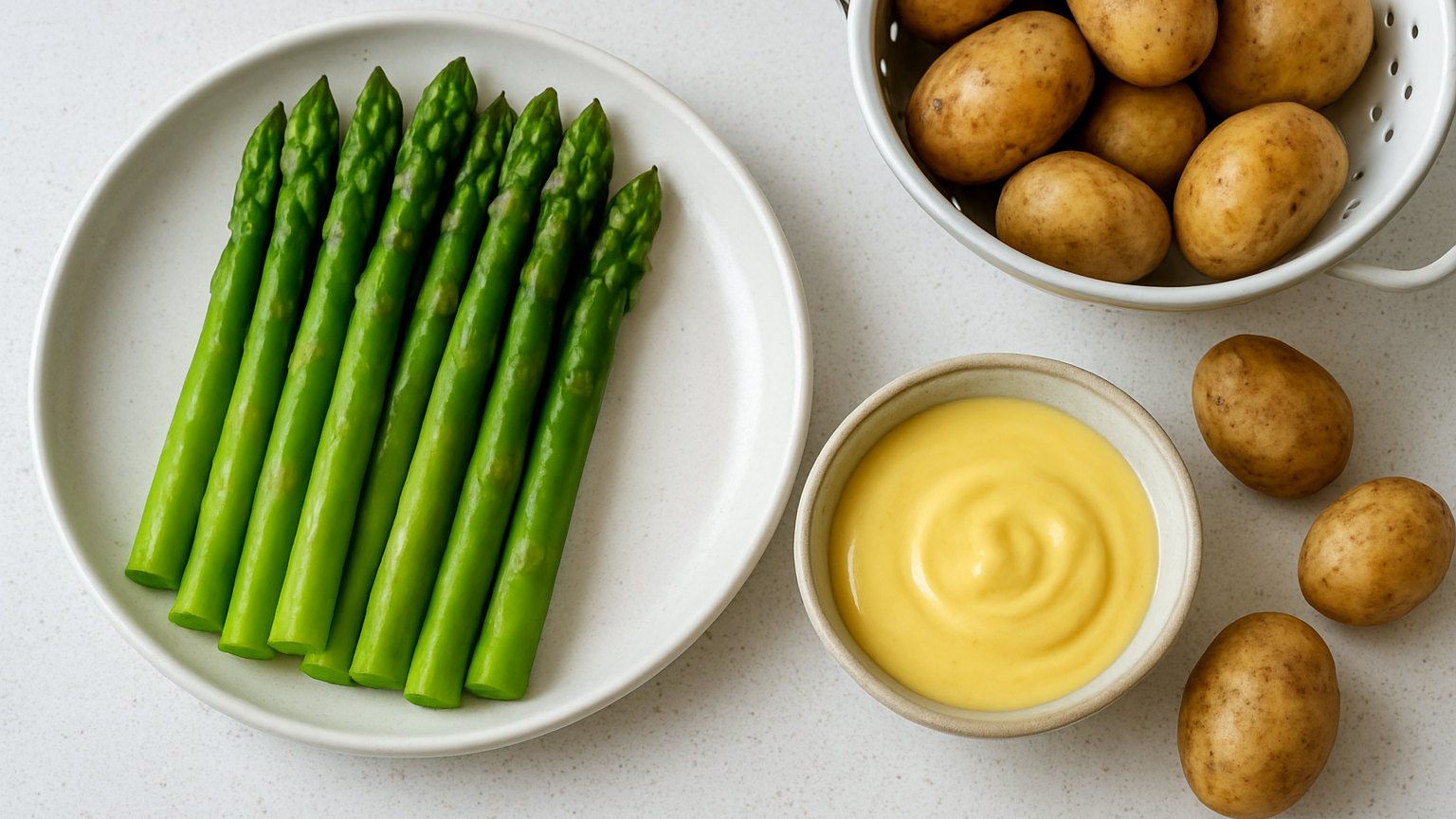
Hollandaise is an emulsion of egg yolk and butter held together by constant whisking and gentle heat. It is the classic partner for asparagus and it has a reputation for difficulty that is only partly deserved. Two things break it: butter added too fast, and a pan that gets too hot. Control both and it is straightforward.
What do you need for 4 people?
- 3 egg yolks
- 200g butter, melted and cooled slightly
- 2 tablespoons white wine vinegar
- 2 tablespoons water
- 1 shallot, finely chopped, and 6 peppercorns
- A squeeze of lemon
- Salt and a pinch of cayenne
How do you make it?
- Simmer the vinegar, water, shallot and peppercorns until reduced to about 2 tablespoons.
- Strain and cool slightly.
- Put the yolks and reduction in a bowl over a pan of barely simmering water.
- Whisk until pale, thickened and the whisk leaves a trail.
- Take the bowl off the heat.
- Add the melted butter drop by drop at first, whisking constantly.
- Once it starts to thicken, pour the rest in a thin steady stream.
- Season with lemon, salt and cayenne and keep warm, not hot.
The bowl must never get hot enough to scramble the yolks. If you can hold your hand against the side of the bowl comfortably, it is fine. Above about 65C the eggs set and the sauce is finished.
Why does it split?
Butter added faster than the yolks can absorb it, or overheating that scrambles the eggs.
The first is far more common and entirely avoidable.
How do you rescue a split sauce?
Whisk a fresh yolk with a teaspoon of water in a clean bowl, then whisk the broken sauce into it a spoonful at a time.
A tablespoon of boiling water whisked in hard sometimes brings back a mildly separated sauce.
Can it be made ahead at all?
Half an hour at most. It is one of the few sauces that genuinely has to be made close to serving.
Should the butter be clarified?
Clarified butter gives a thicker, more stable sauce, since the water in whole butter loosens it.
Melted whole butter works and is easier, giving a slightly lighter result.
How cold should the butter be?
Melted and cooled to warm rather than hot. Very hot butter poured into the yolks will scramble them on contact.
Can it be made in a blender?
Yes, and it is considerably more reliable. Blitz the yolks and reduction, then pour hot melted butter in a thin stream with the motor running.
Why a shallot reduction?
It provides the acidity that balances the butter and the aromatic depth that lemon alone cannot give.
Strain it, since pieces of shallot in the finished sauce are unwelcome.
How do you keep it warm?
In a bowl over warm, not simmering, water, or in a flask. It cannot be reheated once cold.
Make it no more than half an hour ahead.
How thick should it be?
Thick enough to coat the back of a spoon and hold a slight ribbon, and loose enough to pour over asparagus.
Thin it with a teaspoon of warm water if it tightens too much.
What is the difference from bearnaise?
Bearnaise uses a tarragon and vinegar reduction and is finished with more tarragon. The method is identical.
Can lemon replace the reduction?
It can, for a quicker sauce. The shallot and peppercorn reduction gives considerably more depth.
What ratio of butter to yolk?
Roughly 65g of butter per yolk. Three yolks to 200g of butter is a reliable proportion for four people.
More butter gives a richer sauce and a greater risk of splitting.
What else does it go with?
Poached eggs and muffins, salmon, new potatoes, purple sprouting broccoli and globe artichokes.
Anything the sauce can cling to.
Is it safe?
It contains lightly cooked egg. Use British Lion eggs, and the Food Standards Agency advises that these are safe for vulnerable groups, including pregnant women.
Serve it fresh and do not keep it warm for long periods.
Worth reading next: English Asparagus. There is more in our Seasonal recipes.