
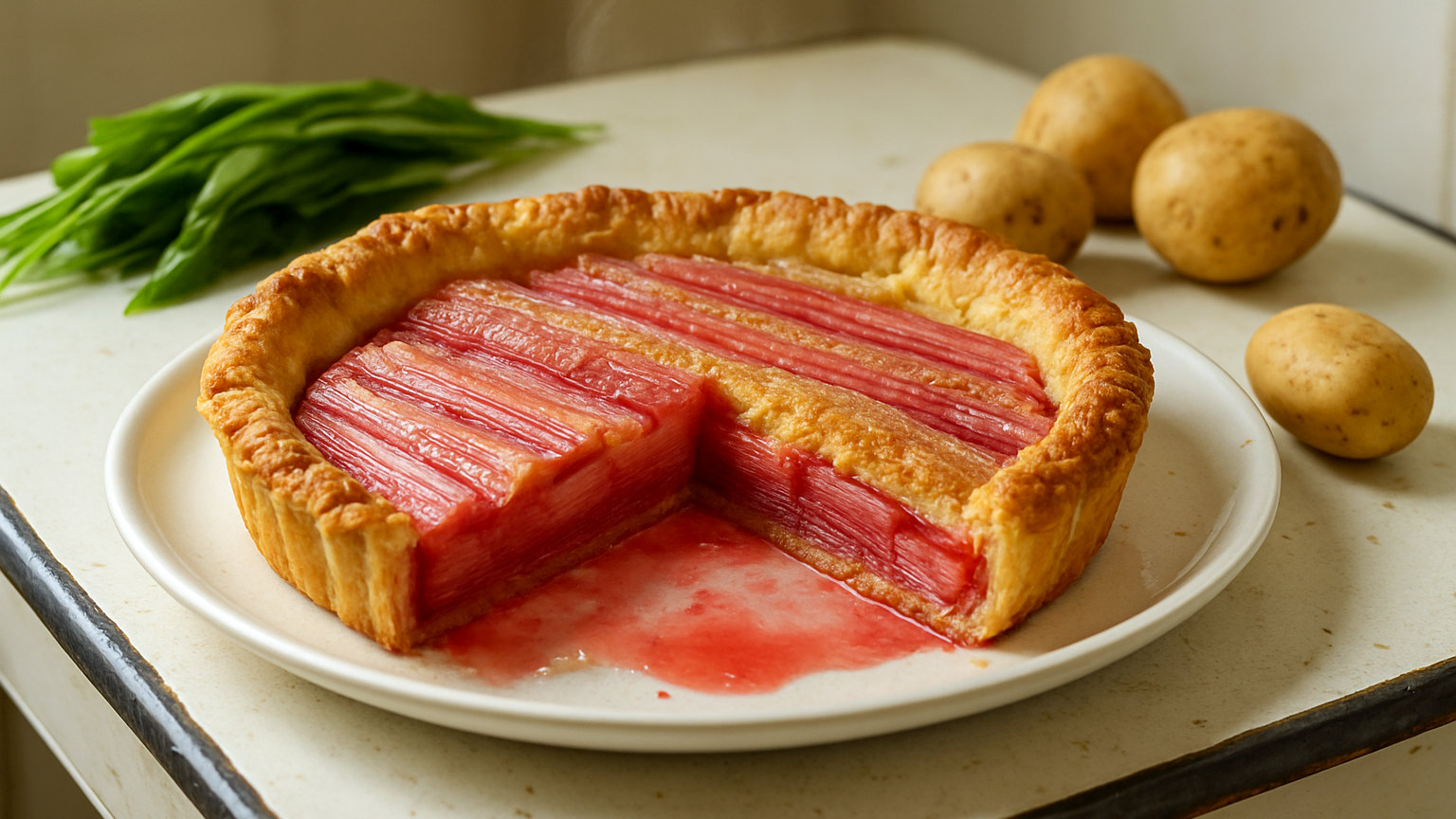
Forced rhubarb is grown in complete darkness in heated sheds, which makes the plant put its stored energy into long pale pink stems rather than leaves. It is picked by candlelight because any real light stops the process. The stems grow so fast that they audibly creak and pop, which is one of the more surprising facts in British food.
How is it forced?
Crowns are grown in fields for two years to build up reserves, then lifted in winter, exposed to frost, and moved into dark heated sheds.
With no light, the plant cannot photosynthesise and instead burns its stored sugars pushing up long tender stems. That is what makes forced rhubarb pale, sweet and delicate.
Why is it picked by candlelight?
Any significant light would trigger normal growth and turn the stems green and tough.
Pickers work by candle in the sheds, which is a genuine working practice rather than a tourist attraction.
How fast does it grow?
Several centimetres a day in a warm shed, which is why the sheds are emptied and replanted in a matter of weeks.
Can you really hear it grow?
Yes. The stems can grow several centimetres a day and the buds and stalks creak and pop audibly in a quiet shed.
Is the season still commercially significant?
Far smaller than at its peak, when hundreds of growers operated and a nightly rhubarb train ran to London. A handful of producers remain.
Protected status has helped stabilise what is left.
Where is the Rhubarb Triangle?
An area of West Yorkshire between Wakefield, Morley and Rothwell, which at its peak produced the majority of the world supply.
Yorkshire Forced Rhubarb holds protected status.
Why West Yorkshire?
Cold winters gave the necessary frost, and the area had cheap coal for heating the sheds and a ready supply of shoddy, a wool waste used as fertiliser.
Rail links carried it to London overnight.
Why is it lifted and frosted first?
Cold triggers the dormancy break, so the crowns need a period of frost before they will respond to warmth in the sheds.
Without it they simply sit and do nothing.
When is the season?
Roughly January to March for forced rhubarb, and April to September for field grown.
The forced season is the one worth waiting for.
Does it need less sugar?
Noticeably less, since forcing concentrates the stored sugars. Start with about half what a field rhubarb recipe calls for and taste.
How is it different from field rhubarb?
Forced rhubarb is pale pink, thin, tender and noticeably sweeter. Field rhubarb is thicker, greener, tarter and more fibrous.
Forced needs less sugar and less cooking.
Why is it so pink?
The pigment develops without chlorophyll masking it, so the stems stay a clear pink rather than turning green.
Field rhubarb grown in light is greener and only pink at the base.
How should it be cooked?
Very briefly, since it collapses fast. Roasting in a low oven with sugar and orange keeps the pieces intact better than stewing.
Ten minutes at 160C fan is often enough.
What goes with rhubarb?
Ginger, orange, vanilla and custard all suit it. Its sharpness needs sugar and something warm alongside.
It also works savoury with oily fish and pork.
Are the leaves poisonous?
Yes. Rhubarb leaves contain oxalic acid in quantities that make them genuinely unsafe to eat and they should always be discarded.
The stems are perfectly safe.
Is rhubarb a fruit or a vegetable?
Botanically a vegetable, since the stem is eaten rather than the fruit. It is treated as a fruit in the kitchen and in law for some purposes.
The same is true of celery, which it superficially resembles.
Should it be peeled?
Forced rhubarb never needs peeling. Thick, coarse field stems late in the season sometimes benefit from stripping the outer skin.
How should it be stored?
Refrigerated, loosely wrapped, for up to a week. It freezes raw in chunks for six months.
Do not store it in a sealed bag, which makes it go slimy.
If that was useful, English Asparagus covers related ground, and there is plenty more in Seasonal recipes.