
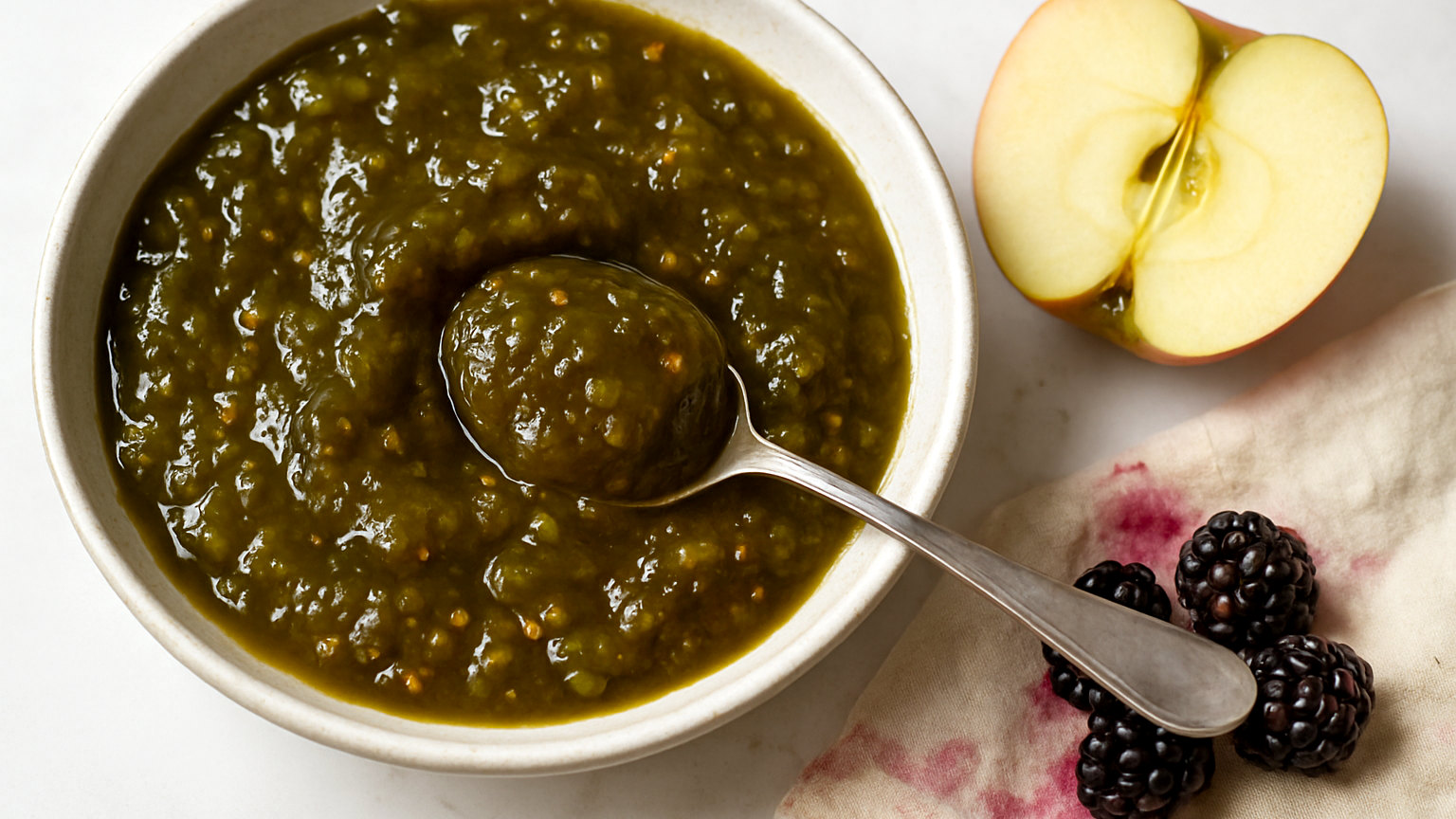
Every year the last tomatoes on the plant fail to ripen before the cold arrives, and green tomato chutney is the traditional answer. It is a long slow cook rather than a difficult one, and the only real discipline it requires is leaving it alone for two months afterwards, which is when it stops tasting harshly of vinegar.
What do you need for about 5 jars?
- 1.5kg green tomatoes, roughly chopped
- 500g onions, chopped
- 2 cooking apples, peeled and chopped
- 250g sultanas or raisins
- 400g soft brown sugar
- 500ml malt vinegar
- 2 tablespoons salt
- 1 tablespoon mustard seeds, 2 teaspoons ground ginger, 1 teaspoon chilli flakes
How do you make it?
- Put the tomatoes, onions, apples and salt in a large heavy pan.
- Add half the vinegar and simmer gently for 45 minutes until soft.
- Add the sugar, remaining vinegar, sultanas and all the spices.
- Stir until the sugar has completely dissolved.
- Simmer uncovered for 1 hour 30 minutes to 2 hours, stirring often.
- Test by drawing a wooden spoon across the base.
- Pot into hot sterilised jars with vinegar proof lids.
- Label and leave in a dark cupboard for 2 months before opening.
The chutney is ready when a spoon drawn across the base leaves a channel that does not fill with liquid. That is the only reliable test, and undercooked chutney separates into solids and vinegar in the jar.
Why does it need maturing?
Fresh chutney tastes raw and sharply of vinegar. Two months lets the acidity mellow and the spices marry.
Three months is better still, and a year is not too long.
Does the salt do anything?
It draws moisture from the vegetables and seasons the whole batch. Two tablespoons for this quantity is right.
Why malt vinegar?
It is the traditional British chutney vinegar, robust enough to stand up to long cooking and heavy spicing.
Cider vinegar gives a lighter, fruitier chutney.
What pan should you use?
A wide heavy stainless steel or enamelled pan. Never use bare aluminium, copper or iron, which react with vinegar and taint the chutney.
Can it be halved?
Yes, and the cooking time reduces to about an hour. Chutney scales cleanly in either direction.
Why are the lids important?
Vinegar corrodes bare metal. Use plastic coated lids sold for pickling, or a waxed disc and a vinegar proof cover.
A corroded lid will ruin an otherwise good jar.
Does it need to be stirred constantly?
Not for the first hour, and increasingly towards the end as it thickens and starts to catch on the base.
Can it be made with ripe tomatoes?
Yes, and it will be sweeter and softer, needing slightly less sugar and less cooking.
Green tomatoes give the sharper, firmer chutney.
Should the vegetables be finely chopped?
Fairly evenly and not too small, since everything breaks down over two hours. A rough 1cm dice is right.
Very fine chopping gives a purée rather than a chutney.
What else can go in?
Marrow, courgette, plums, beetroot or peppers all work in the same base.
How much does this make?
About five 350g jars, which is a year of chutney for most households and enough to give some away.
What does it go with?
Cheese above all, plus cold meats, pork pie, sausages and a ploughmans.
How should the jars be sterilised?
Washed in hot soapy water and dried in a 140C oven for 15 minutes, then filled while both jars and chutney are hot.
Cold chutney in hot jars or the reverse can crack the glass.
Why does it need such a long cook?
The vinegar and water have to evaporate until the chutney is thick. Two hours is normal and rushing it gives a runny result.
Stir often towards the end, since it catches easily.
How long does it keep?
Two years unopened in a cool dark cupboard, and a month refrigerated once opened.
Discard any jar that is mouldy, bulging or smells fermented, in line with Food Standards Agency guidance.
If that was useful, British Apple Varieties covers related ground, and there is plenty more in Seasonal recipes.