
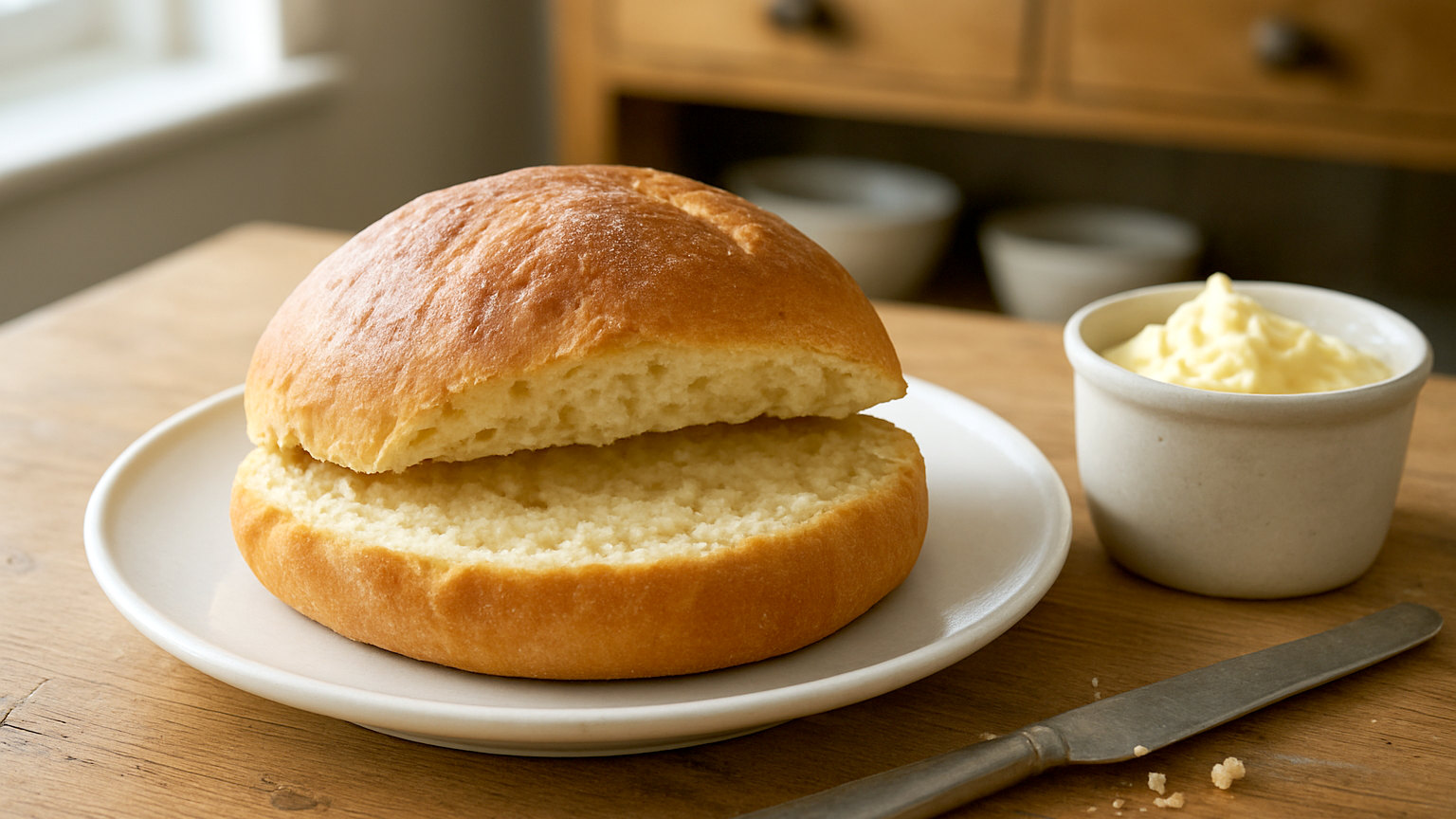
A Sally Lunn is a large, round, very light bun from Bath, enriched with butter, eggs and cream but barely sweetened. It is closer to a French brioche than to any other British bread, and it is served cut horizontally into rounds, toasted and spread with butter or a savoury topping. It has been made in Bath since at least the eighteenth century.
What do you need for 2 large buns?
- 500g strong white bread flour
- 7g fast action yeast and 1 teaspoon salt
- 25g caster sugar
- 100g butter, softened
- 3 eggs, beaten
- 150ml warm milk
- 50ml double cream
- 1 beaten egg to glaze
How do you make it?
- Combine the flour, yeast, salt and sugar, keeping salt and yeast apart initially.
- Add the eggs, milk and cream and mix to a very soft dough.
- Work in the softened butter a little at a time.
- Knead for 10 minutes until smooth and glossy.
- Prove for 2 hours until doubled.
- Divide into two and shape into rounds in greased 15cm cake tins.
- Prove for 1 hour until well risen.
- Glaze and bake at 180C fan for 25 minutes until deep golden.
Add the butter after the dough has come together, not at the start. Working it in gradually lets the gluten develop first, which is what gives the light, open crumb rather than a heavy one.
How is it served?
Cut horizontally into two or three rounds, toasted, and spread with butter, jam or clotted cream. Savoury toppings are equally traditional.
The bun is deliberately plain enough to go either way.
How big should it be?
Large, around 15cm across, which serves several people in slices. It is not an individual bun.
How many does one bun serve?
Two or three people, cut into horizontal rounds. It is shared rather than eaten whole by one person.
Who was Sally Lunn?
The traditional story names a young French refugee baker who arrived in Bath in the 1680s. There is no firm documentary evidence for her.
The name may instead derive from a French term for a similar bun.
Why is the dough so soft?
The high proportion of egg, milk and cream makes a batter like dough, which is what produces the very light open crumb.
It should be sticky and slack rather than firm.
Is it sweet?
Only slightly. There is far less sugar than in a Bath bun, which is why it works with savoury toppings.
Should it be toasted?
Traditionally yes, cut into rounds and toasted under a grill, which crisps the surface while the crumb stays light.
How is it different from brioche?
Very little in method. Brioche generally uses more butter and eggs and no cream, and a Sally Lunn is baked much larger.
Can it be made as one very large bun?
Yes, in a 20cm tin, baking for around 35 minutes. It is traditionally sold large and cut into rounds.
Check the centre is cooked with a skewer.
Why does it need a tin?
The dough is very soft and would spread flat on a tray. A tin holds it up so it rises tall.
Does it contain cream?
A little double cream in the dough is traditional and adds to the softness of the crumb. Milk alone works.
Can it be made in a mixer?
It is considerably easier that way, since the dough is too soft to knead comfortably by hand.
Use a dough hook for 8 minutes on a medium speed.
What savoury toppings suit it?
Toasted with cheese, potted meats, smoked salmon or a mushroom filling. It is plain enough to carry any of them.
That versatility is why it survives as a Bath institution.
How do you know it is baked?
Deep golden on top and hollow sounding when tapped underneath. Twenty five minutes is usual for a 15cm bun.
How long does it keep?
Two days wrapped and it toasts well on the second day. It freezes for a month.
For something along the same lines, see Stargazy Pie, or browse all our Regional recipes.


