
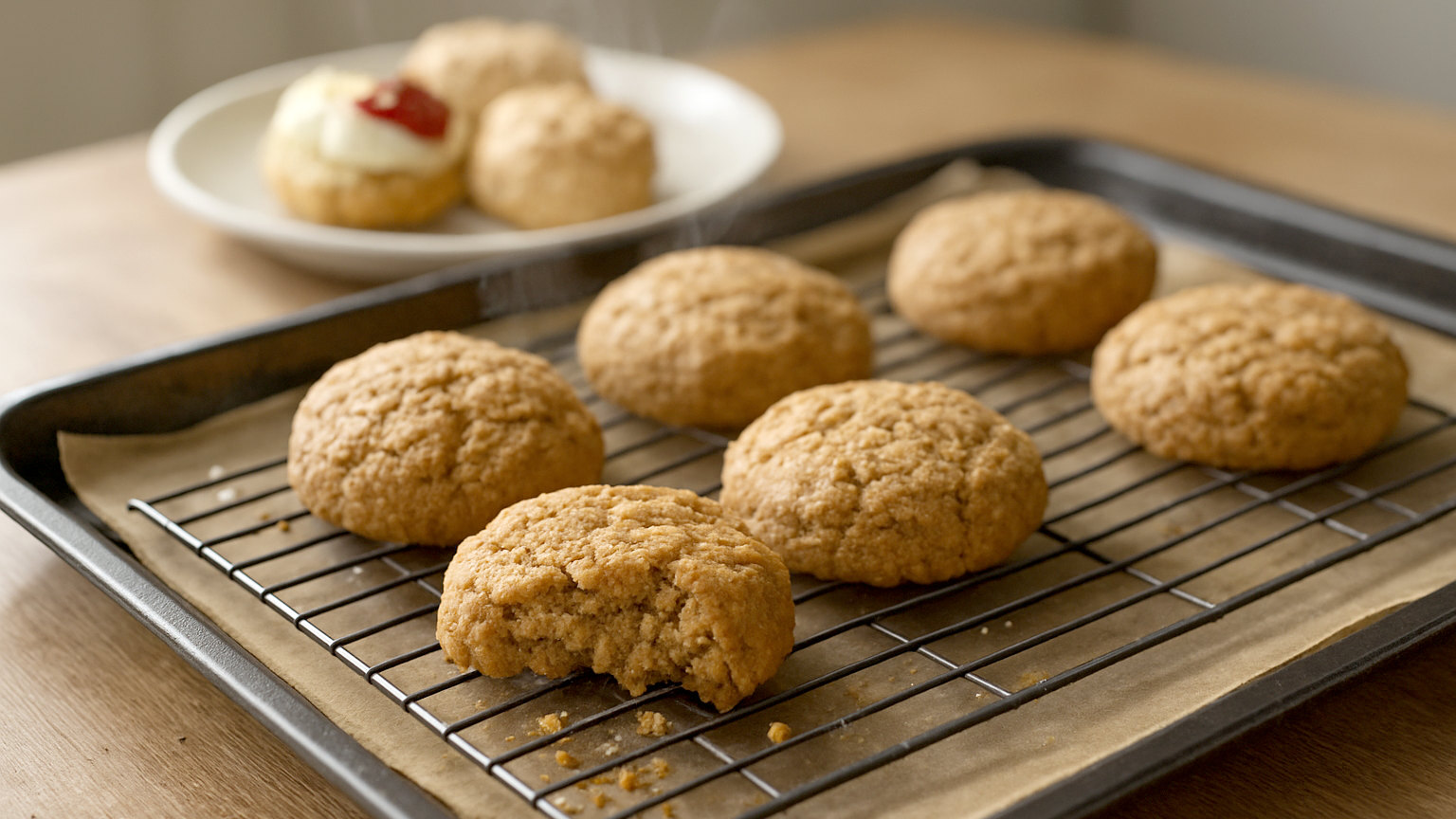
Cornish fairings are crisp, crackled ginger biscuits, originally sold at fairs across Cornwall as a gift to take home. They spread and crack as they bake into a characteristic pattern, and the way to encourage that is to bang the tray down hard partway through baking, which collapses them and creates the fissures.
What do you need for about 20 biscuits?
- 150g plain flour
- 1 teaspoon baking powder and 1 teaspoon bicarbonate of soda
- 2 teaspoons ground ginger
- 1 teaspoon mixed spice and 1 teaspoon ground cinnamon
- 75g cold butter, diced
- 75g caster sugar
- 4 tablespoons golden syrup
How do you make them?
- Heat the oven to 180C fan, 200C conventional, gas mark 6.
- Sift the flour, raising agents and spices together.
- Rub in the butter until it resembles breadcrumbs.
- Stir in the sugar.
- Warm the golden syrup slightly and stir it in to make a stiff dough.
- Roll into walnut sized balls and space them well apart on lined trays.
- Bake for 8 minutes, then open the oven and bang the tray down firmly on the shelf.
- Bake for a further 3 to 4 minutes until deep golden, then cool on the tray.
Bang the tray down hard at the eight minute mark. The biscuits have risen and are still soft, and the shock collapses them into the cracked, crazed surface that defines a fairing.
Why do they need space?
They spread considerably, roughly doubling in width. Six to a large tray is about right.
Crowded, they merge into one sheet.
Why both baking powder and bicarbonate of soda?
The bicarbonate of soda reacts with the acidic golden syrup and gives the spread, while the baking powder provides lift.
Together they produce the rise and collapse that makes the cracks.
Why do they go soft?
They were underbaked, or stored before they were completely cold. They crisp as they cool on the tray.
Damp air also softens them, so keep them airtight.
Do they need chilling before baking?
No, and chilling would work against the spread. Roll them and bake them straight away.
What is a fairing?
Originally any small gift bought at a fair. In Cornwall the word came to mean these biscuits specifically.
They were sold at fairs and taken home for those who had not gone.
Why cool them on the tray?
They are soft when they come out and firm as they cool. Moving them early breaks them.
Give them five minutes on the tray before transferring to a rack.
How are they different from gingernuts?
Fairings are more heavily spiced with mixed spice and cinnamon as well as ginger, and they are flatter with a cracked surface.
A gingernut is domed and denser.
Should the syrup be measured carefully?
Yes. Too much and they spread into a single sheet, too little and they stay domed and will not crack.
Four level tablespoons for 150g of flour is right.
Can they be made larger?
Yes, and they will need an extra couple of minutes and considerably more space between them.
Can the spice be adjusted?
The ginger can go up to three teaspoons for a stronger biscuit. Keep the mixed spice and cinnamon, which are what distinguish a fairing.
Fresh ground spice makes a noticeable difference.
Should they be soft in the middle?
No. A fairing is crisp all the way through, which is what makes it keep.
Why golden syrup rather than sugar alone?
It is an invert sugar, which keeps the biscuits crisp rather than hard and helps them spread.
It also reacts with the bicarbonate of soda, which drives the cracking.
How big should the dough balls be?
About the size of a walnut, roughly 20g. They spread to around 7cm across.
Keep them even so they bake at the same rate.
How long do they keep?
Two weeks in an airtight tin, which is why they travelled well as gifts.
They freeze as raw dough balls for three months.
Worth reading next: Cornish Saffron Buns. There is more in our Regional recipes.


