
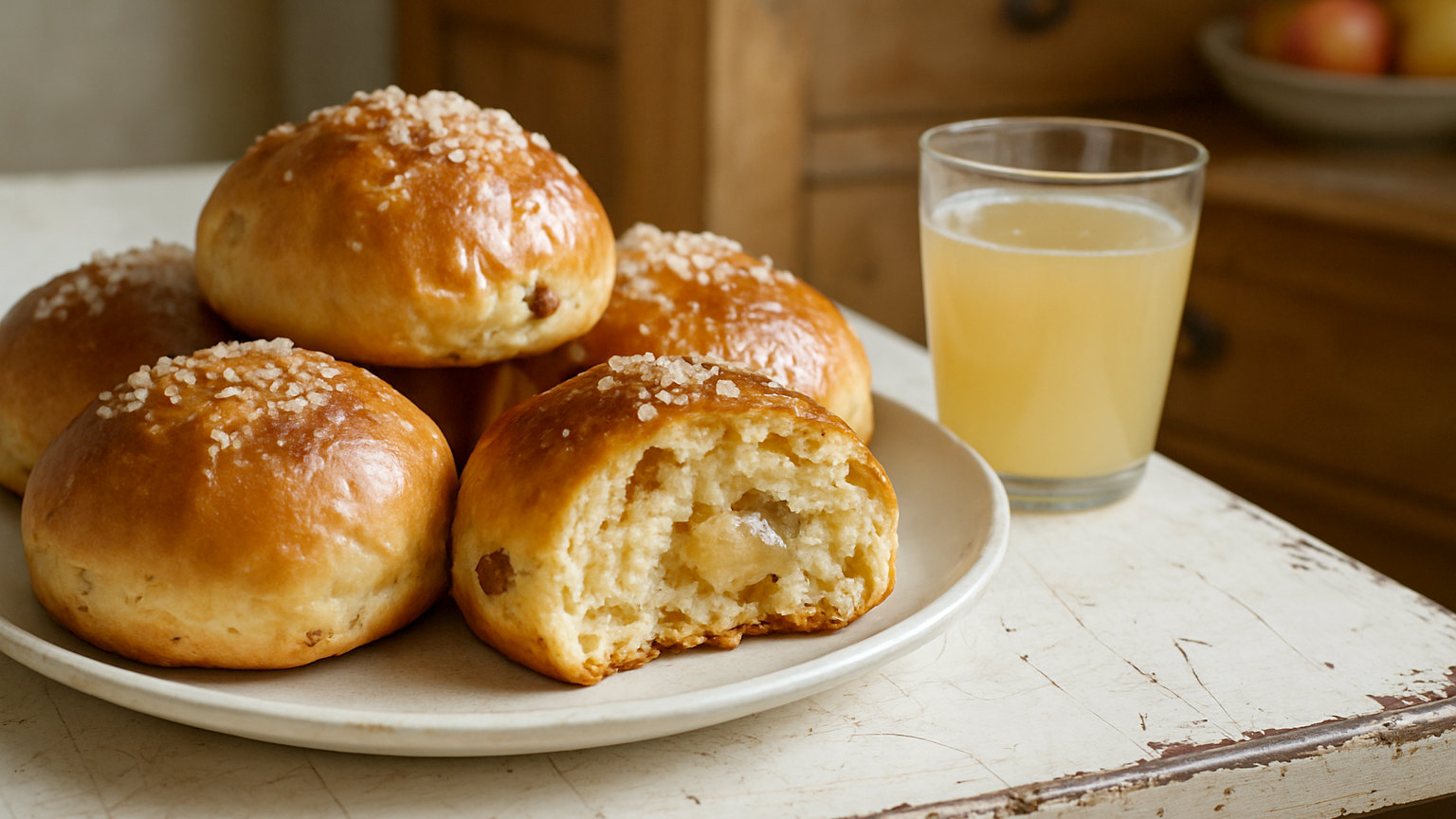
A Bath bun is a rich, sweet, slightly craggy yeast bun scattered with crushed sugar nibs, with a lump of sugar traditionally hidden in the base. It is considerably richer than most British buns, with a high proportion of butter and eggs, and it is quite unlike a Chelsea bun, which is a rolled spiral.
What do you need for 10 buns?
- 450g strong white bread flour
- 7g fast action yeast and 1 teaspoon salt
- 50g caster sugar
- 125g butter, softened
- 3 eggs, beaten
- About 100ml warm milk
- 100g sultanas and 50g mixed peel
- 10 sugar lumps, plus 50g crushed sugar nibs for the top
- 1 beaten egg to glaze
How do you make them?
- Combine the flour, yeast, salt and sugar, keeping salt and yeast apart initially.
- Add the eggs, softened butter and enough warm milk for a soft, sticky dough.
- Knead for 10 minutes, which will be messy, until smooth and elastic.
- Prove for 2 hours until doubled.
- Knock back and work in the sultanas and peel.
- Divide into 10 pieces, pressing a sugar lump into the base of each.
- Shape into rough rounds, spaced on trays, and prove for 45 minutes.
- Glaze, scatter with crushed sugar and bake at 190C fan for 15 minutes.
The dough should be sticky and difficult. That richness is the whole point of a Bath bun, and adding flour to make it comfortable to handle gives an ordinary bun instead.
Should they be spaced apart?
Yes, generously, since they spread as they prove and bake. Five to a large tray is about right.
What are sugar nibs?
Coarse crushed sugar lumps, also sold as nib sugar or pearl sugar. They do not melt fully in the oven and stay as visible crunchy pieces.
Crush sugar lumps in a bag with a rolling pin if you cannot buy them.
How large should each bun be?
About 90g of dough each, which gives ten from this quantity. They are meant to be substantial.
Why hide sugar in the base?
It is the traditional feature. The lump partly melts during baking and gives a sweet, slightly caramelised patch underneath.
How is it different from a Chelsea bun?
A Chelsea bun is a rolled spiral packed tightly in a tin and glazed sticky. A Bath bun is a single rough round, richer, with crunchy sugar on top.
Different doughs, different shapes and different textures.
Should they contain fruit?
Sultanas and mixed peel are traditional, though some versions are plain with only the sugar on top.
Keep the quantity modest, since the dough is already very rich.
How is it different from a Sally Lunn?
A Sally Lunn is a large, light, barely sweet bun, closer to a brioche and served in slices. A Bath bun is small, heavy and sweet.
What is the sugar on top?
Nib or pearl sugar, or crushed sugar lumps, which stay in visible crunchy pieces rather than dissolving.
Caster sugar melts away and gives none of the texture.
Why should they look craggy?
They are shaped roughly rather than smoothed into neat balls, which is the traditional appearance.
Why does it take so long to prove?
Butter, eggs and sugar all slow the yeast considerably. Two hours for the first prove is normal for a dough this rich.
How should they be served?
Warm, split and buttered, with tea. They need no jam.
Why are they so rich?
Bath was a fashionable spa town in the eighteenth century and its baking reflected wealthy visitors rather than working households.
Three eggs and 125g of butter to 450g of flour is a very rich ratio by British standards.
Can they be made in a mixer?
It is considerably easier, since the dough is too sticky to knead comfortably by hand. Use a dough hook for 8 minutes.
How long do they keep?
Two days in a tin and best on the day. They freeze for a month.
Next, try Cornish Saffron Buns, or see the rest of our Regional recipes.


