
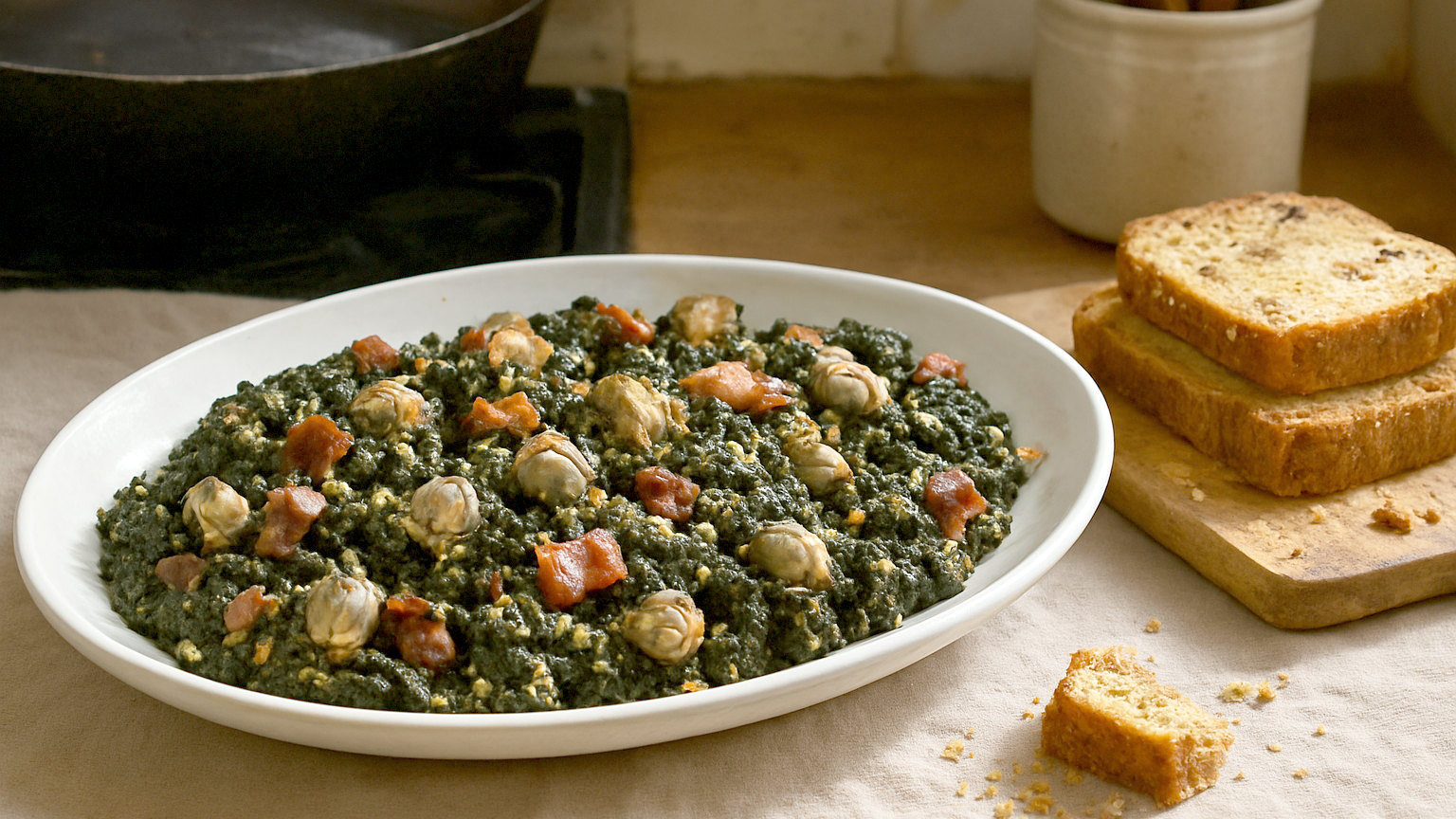
Laverbread is not bread. It is laver seaweed boiled for hours until it collapses into a dark green puree, and it has been eaten in south Wales for centuries. Fried with oatmeal and served with cockles and bacon, it makes a breakfast that is genuinely unlike anything else in British cooking.
What do you need for 4 people?
- 400g prepared laverbread
- 300g cooked cockles
- 8 rashers of streaky bacon
- 4 tablespoons medium oatmeal
- Bacon fat or butter for frying
- Black pepper and a squeeze of lemon
- Buttered toast to serve
How do you cook it?
- Fry the bacon until crisp and set aside, keeping the fat in the pan.
- Mix the laverbread with 2 tablespoons of the oatmeal.
- Shape into small flat cakes and coat them in the remaining oatmeal.
- Fry in the bacon fat for 3 minutes a side until crisp at the edges.
- Add the cockles to the pan for the last minute to warm through.
- Season with black pepper and a squeeze of lemon.
- Serve with the bacon and buttered toast.
Warm the cockles for a minute and no longer. They are already cooked and they toughen into rubber very quickly. They need heating rather than cooking.
What exactly is laverbread?
Laver, a thin purple seaweed, washed repeatedly and then boiled for five or six hours until it breaks down into a smooth dark puree.
It is sold ready prepared in tins and tubs, which is how almost everyone buys it.
Is it the same as Japanese nori?
The seaweed is closely related, though nori is dried into sheets while laver is boiled to a puree. The raw material is much the same.
What does it taste like?
Savoury, mineral and strongly of the sea, closer to a very intense spinach than to fish.
It is far milder than its appearance suggests.
Why the oatmeal?
Laverbread is very wet and will not hold a shape or crisp on its own. Oatmeal binds it and gives a crust when fried.
Medium oatmeal is right. Rolled oats stay flat and papery.
Where do the cockles come from?
Penclawdd on the Gower peninsula, where cockles have been gathered from the Loughor estuary for generations, traditionally by hand at low tide.
They are sold cooked and shelled.
Can you make laverbread yourself?
You can, and it takes five or six hours of boiling plus a great deal of washing to remove the sand.
Buying it prepared is the sensible option and it is widely available in Wales.
How are cockles gathered?
Raked from the sand at low tide and sieved, traditionally by hand and carried by donkey at Penclawdd. The beds are licensed and managed.
Never gather shellfish yourself without checking local water quality notices.
Is it good for you?
It is high in iodine, iron and vitamins, and very low in fat. It is also high in salt, so it needs little seasoning.
How much per person?
About 100g of laverbread and 75g of cockles each as part of a cooked breakfast.
It is rich and salty, so a small portion goes a long way.
Can you eat it cold?
Straight from the tub it is edible and unappealing. Frying it with oatmeal is what makes it worth eating.
What else can you do with it?
Stirred into a sauce for Welsh lamb, spread on toast, or added to a butter for fish.
A spoonful in a stew adds savoury depth.
Is it part of a Welsh breakfast?
It is the defining element of one, alongside bacon, eggs and cockles. A full Welsh breakfast is otherwise close to a full English.
It is most common in the south and west.
How should it be stored?
Refrigerated once opened and used within two days, or frozen for three months.
Cooked cockles should be kept chilled and eaten within a day of opening, in line with Food Standards Agency guidance on shellfish.
Worth reading next: Bara Brith. There is more in our Regional recipes.


