
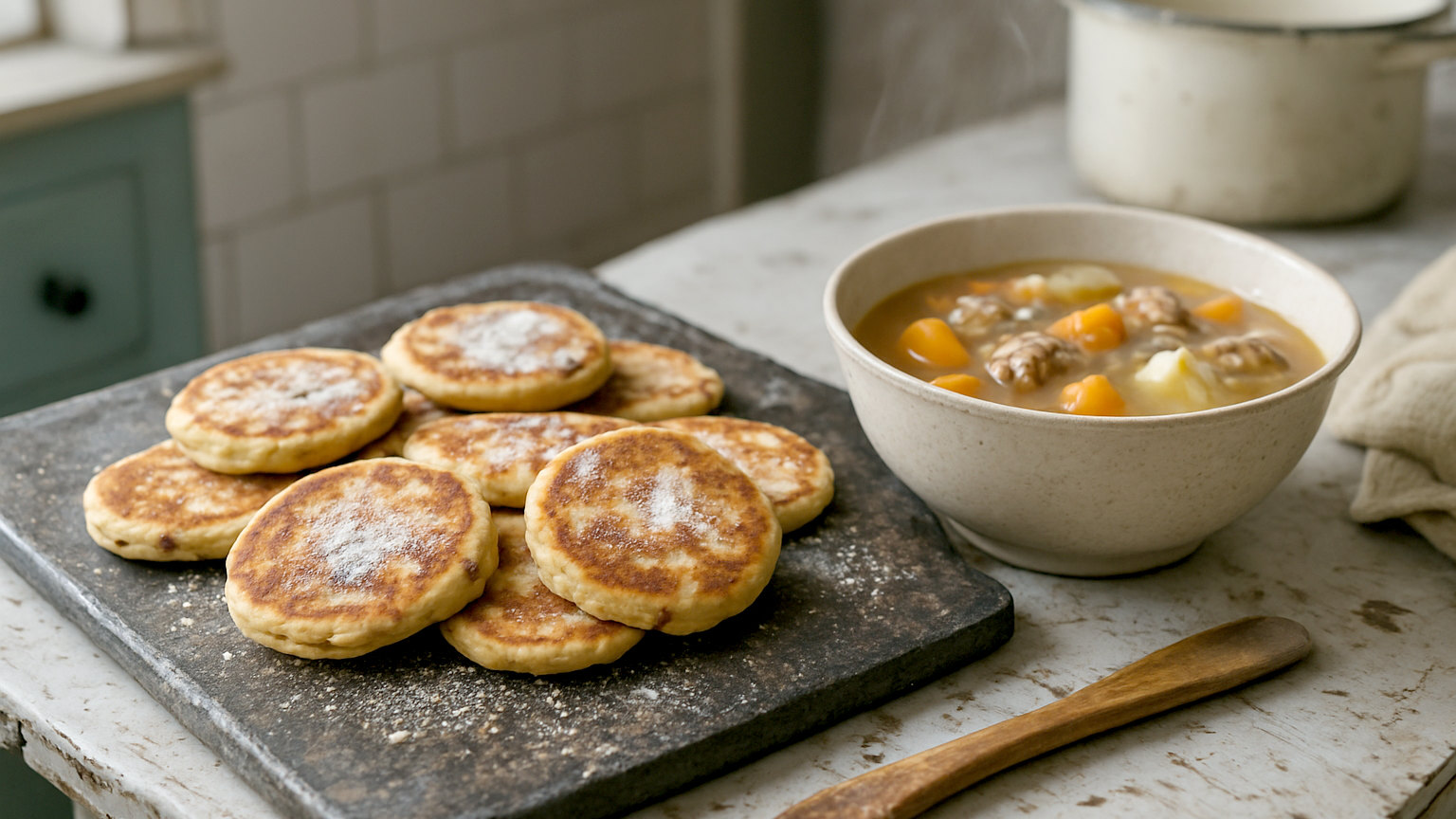
A great deal of Welsh baking is cooked on a flat surface rather than in an oven, and the reason is straightforward. Rural Welsh households frequently had no oven at all, only an open fire with a flat iron plate over it. Welsh cakes, pancakes, planc bread and crempog all come from that constraint, and it shaped what Welsh baking looks like.
What is a bakestone?
A thick flat plate of iron or stone, heated over a fire, called a maen or a planc in Welsh. It provided a cooking surface where no oven existed.
The English equivalent is a griddle, and the Scottish is a girdle.
What can you use instead?
A heavy cast iron frying pan is the practical substitute and works perfectly. The important quality is thickness, which holds a steady heat.
A thin pan develops hot spots and burns things unevenly.
Why is a thick plate better?
Thermal mass. A thick iron plate holds its heat when cold dough is placed on it, while a thin pan drops in temperature immediately and cooks unevenly.
How hot should it be?
Medium low, and lower than most people set it. Griddled items need three or four minutes a side to cook through, and a hot pan browns them in ninety seconds with a raw centre.
Test it with one item before committing the batch.
How do you judge the heat?
A pinch of flour dropped on the surface should turn light brown in about a minute. If it darkens immediately the pan is too hot.
Let it cool for a couple of minutes and test again.
Should it be greased?
Lightly and wiped, rather than coated. Most griddle recipes contain enough fat that a well seasoned pan needs almost nothing.
Too much fat fries rather than griddles.
What is cooked this way?
Welsh cakes, crempog which are thick Welsh pancakes, planc bread, pikelets and oatcakes.
Scottish tattie scones and Northern Irish soda farls belong to the same family.
Is it the same as a Scottish girdle?
The same object under a different name, and the traditions overlap considerably. Both produced flat, quick, chemically raised baking.
What is planc bread?
A soda raised loaf cooked flat on the bakestone rather than in a tin, turned once so both sides brown.
It is dense and close textured compared with an oven loaf.
Do you turn things once or twice?
Once for most griddle baking. Turning repeatedly stops a crust forming and gives a pale, tough result.
Wait until the first side is properly coloured before turning.
What is crempog?
A thick Welsh pancake, often raised with buttermilk and soda, stacked in a pile and buttered between the layers.
They were traditionally made for birthdays and Shrove Tuesday.
What is a pikelet?
A flat yeasted batter cake cooked on a griddle, thinner than a crumpet and without the deep holes. It is Welsh in origin, from bara pyglyd.
The name travelled into the English Midlands and the north.
Why does it matter to the tradition?
It explains why so much Welsh baking is flat, quick and raised chemically rather than by yeast. Nothing tall or slow could be cooked on a plate over a fire.
Bara brith is the exception and was often taken to a communal oven.
Do you need to preheat it for long?
Ten minutes over a low to medium heat, which lets the whole plate come to an even temperature. Thick iron heats slowly and holds it well.
Rushing the preheat gives a hot centre and cold edges.
Can you use it on an induction hob?
Cast iron works on induction. A traditional stone bakestone does not, since it is not magnetic.
A heavy iron pan is the practical choice on any modern hob.
How do you look after a bakestone?
Like any cast iron: wipe rather than scrub, dry it thoroughly and keep it lightly oiled to prevent rust.
Never leave it wet.
Worth reading next: Anglesey Eggs. There is more in our Regional recipes.


