
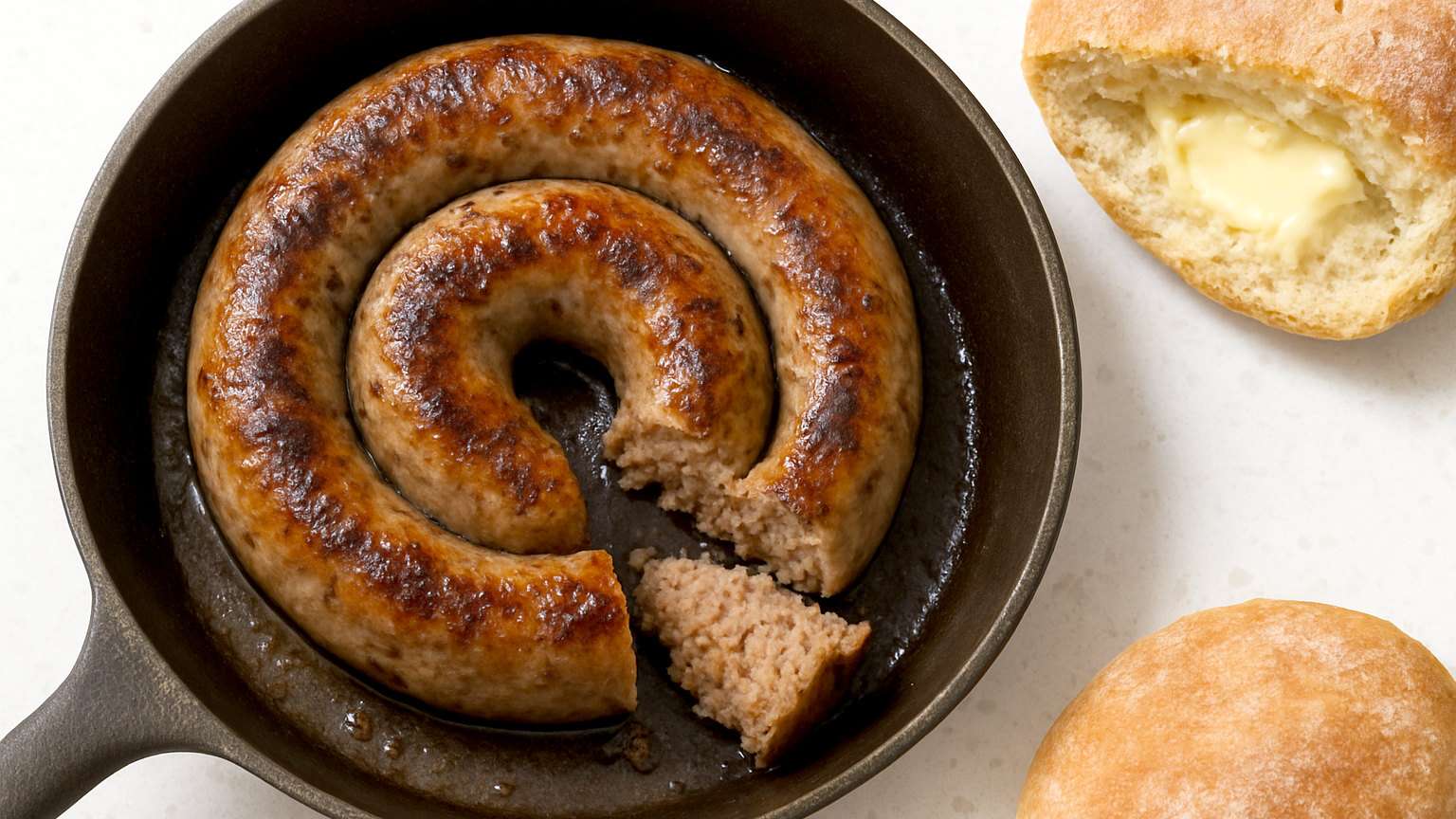
Cumberland sausage is sold as a long continuous coil rather than in links, made from coarsely chopped rather than finely minced pork, and seasoned heavily with black pepper. Traditional Cumberland Sausage holds protected status, which defines the meat content, the chop and the fact that it must be made in Cumbria.
What does protected status require?
At least 80 per cent meat, coarsely chopped, and made in Cumbria. The specification also requires it to be sold in a coil rather than linked.
Sausage sold simply as Cumberland style need meet none of that.
Why a coil?
It is the traditional form and it was sold by length rather than by the link, cut from a long coil at the counter.
Butchers still sell it by the yard in parts of Cumbria.
Why coarsely chopped?
Chopping rather than mincing leaves distinct pieces of meat and fat, which gives a much coarser, meatier texture than an ordinary sausage.
You can see the individual pieces in a cut slice.
How is it seasoned?
Heavily with black pepper, and traditionally little else beyond salt. Some producers add mace, nutmeg, sage or thyme.
The pepper should be assertive.
Should it be cut before cooking?
Cook it whole and cut it into wedges at the table, which keeps the juices in and looks considerably better.
How do you cook a whole coil?
Skewer it crossways with two metal skewers to hold the spiral together, then bake at 190C fan for 30 to 35 minutes, turning once.
It can also be pan fried over a medium heat for about 20 minutes, turned carefully.
Does it contain rusk?
Very little or none, since the protected specification requires a high meat content. Ordinary sausages contain considerably more.
That is why it shrinks less in the pan.
Should it be pricked?
No. Pricking lets the fat and juices out and dries the sausage. Cook it at a moderate heat and it will not split.
Where does the name come from?
From the old county of Cumberland, now part of Cumbria, where pigs were widely kept on smallholdings and the sausage was a way of using the whole animal.
The county name survives in the sausage even though it no longer exists administratively.
What temperature should it reach?
75C in the centre, with no pink meat and clear juices, in line with Food Standards Agency guidance.
A thick coil takes longer than you expect, so check with a probe.
Can it be barbecued?
A skewered coil cooks well over medium coals in about 20 minutes, turned regularly. Keep it away from fierce direct heat, which splits the casing.
What should you serve with it?
Mash and onion gravy, or with apple sauce, which suits the pepper well. Cut the coil into wedges at the table.
What cut of pork is used?
Shoulder and belly, which give the right balance of meat to fat. Around 20 to 30 per cent fat is needed to keep it moist.
Very lean sausage is dry whatever else is done to it.
How is it different from an ordinary pork sausage?
Higher meat content, coarser texture, more pepper and no rusk or very little.
It is closer to a fresh butchers sausage than to a supermarket one.
How long is a coil?
Traditionally sold by length, and a coil for four people is around 450g, which unrolls to about half a metre.
Butchers in Cumbria will cut whatever length you ask for.
Why is it not linked?
Linking requires twisting the casing at intervals, which the coarse chopped filling does not suit as well, and the coil is simply the local tradition.
The protected specification requires it.
Can you make it at home?
Yes, with hand chopped pork shoulder and belly, plenty of pepper and sausage casings, though it cannot be called Cumberland unless made in Cumbria.
How should it be stored?
Refrigerated and used within two or three days, or frozen for three months.
Coil it flat on a tray to freeze so it keeps its shape.
For something along the same lines, see Cumberland Rum Nicky, or browse all our Regional recipes.


