
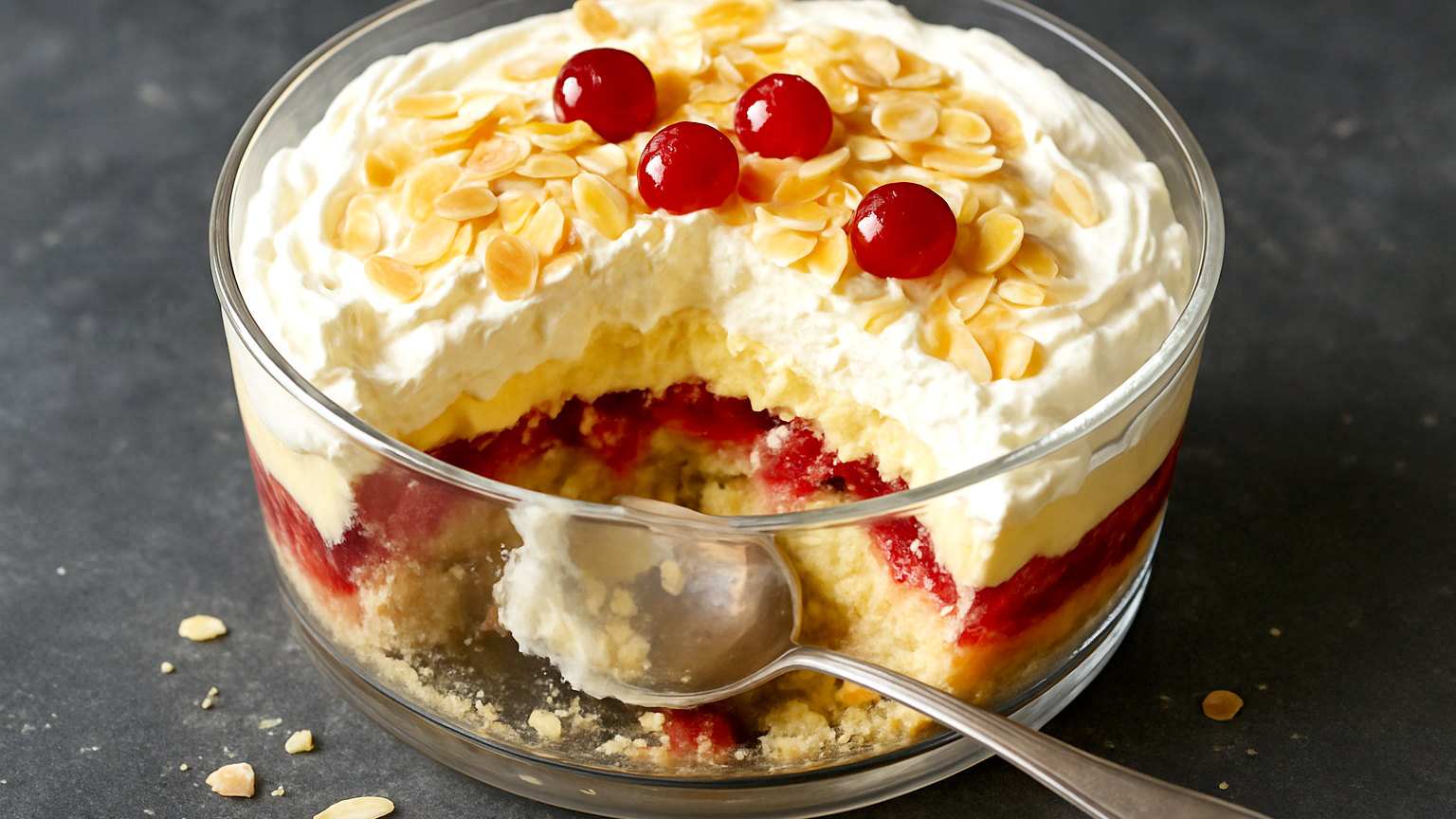
The sponge at the bottom of a trifle has a specific job. It has to soak up alcohol and fruit juice, hold that liquid without turning to paste, and support several centimetres of custard and cream above it. That rules out some cakes entirely and makes slightly stale cake better than fresh, which is counterintuitive.
What makes a good trifle sponge?
A close, firm crumb. It absorbs liquid steadily and keeps its structure rather than dissolving.
Slightly stale cake works better than fresh. A day or two old, the crumb has firmed up and it soaks without collapsing, which is why trifle was traditionally a way of using up cake.
Is Madeira cake the best choice?
Probably, since its close firm crumb is exactly what the job needs. It holds sherry well and does not fall apart.
Plain sponge cake works and is softer.
What about shop bought trifle sponges?
They are made for the purpose, they are dry and absorbent, and they are entirely respectable. Eight of them line a large bowl neatly.
They are blander than cake, which some people prefer since it lets the sherry come through.
Does Swiss roll work?
Very well, and it is a common choice. Sliced into rounds it gives a spiral of jam through the base and saves spreading jam separately.
It is soft, so do not oversoak it.
Should it be toasted or dried out?
A few minutes in a low oven dries fresh cake enough to use straight away, which is worth doing if you have no stale sponge to hand.
What about sponge fingers?
Boudoir biscuits or savoiardi are dry and very absorbent, which makes them good for individual trifles.
They soften quickly, so add the liquid shortly before assembling.
How much sponge do you need?
About 300g of cake, or eight trifle sponges, for a trifle serving eight in a 2.5 litre bowl.
It should sit about 5cm deep once packed down.
Which cakes do not work?
A very light whisked sponge dissolves into paste. Anything with a heavy fruit content or a dense oil crumb is too rich.
Chocolate cake works only in a chocolate trifle, since it dominates everything else.
How much liquid should it take?
About 150ml of sherry for a trifle serving eight, plus whatever the fruit releases.
The sponge should be damp throughout and not sitting in a pool.
Should it be a solid layer?
Pack the pieces closely with no large gaps, since gaps fill with custard and the layers lose definition.
Press it down lightly rather than compacting it.
Does the sponge need to be dry?
Drier is better, since a dry sponge draws liquid in and holds it. Fresh moist cake has nowhere to put the sherry and it pools at the bottom.
Leaving slices out uncovered for a few hours dries them enough.
Should it line the sides too?
Only the base in a classic trifle. Sponge up the sides looks striking and absorbs juice unevenly, so it is a matter of appearance rather than technique.
Individual glasses are the exception, where a piece against the glass shows well.
Can you use leftover cake?
That is what trifle is for. Dry Victoria sponge, the ends of a Madeira, or a cake that sank in the middle all work.
Cut away anything with icing on it, which turns the sherry cloudy.
Should the sponge be spread with jam?
Traditionally yes. Jam adds sharpness against the custard and helps stick the pieces together into a solid base.
Raspberry is usual. Apricot and blackcurrant both work.
Does it need to be sponge at all?
Amaretti biscuits, ratafias or crushed shortbread all make a base, though they give a firmer, crunchier layer rather than a soaked one.
Macaroons were common in older recipes.
How thick should the layer be?
About a quarter of the total depth. Much more and the trifle is stodgy, much less and it will not support the layers above.
Cool and cover any leftover cake and use it within the times for that cake, in line with Food Standards Agency guidance.
See also Making a Trifle Ahead: Timings and Assembly, or browse more Puddings recipes.

