
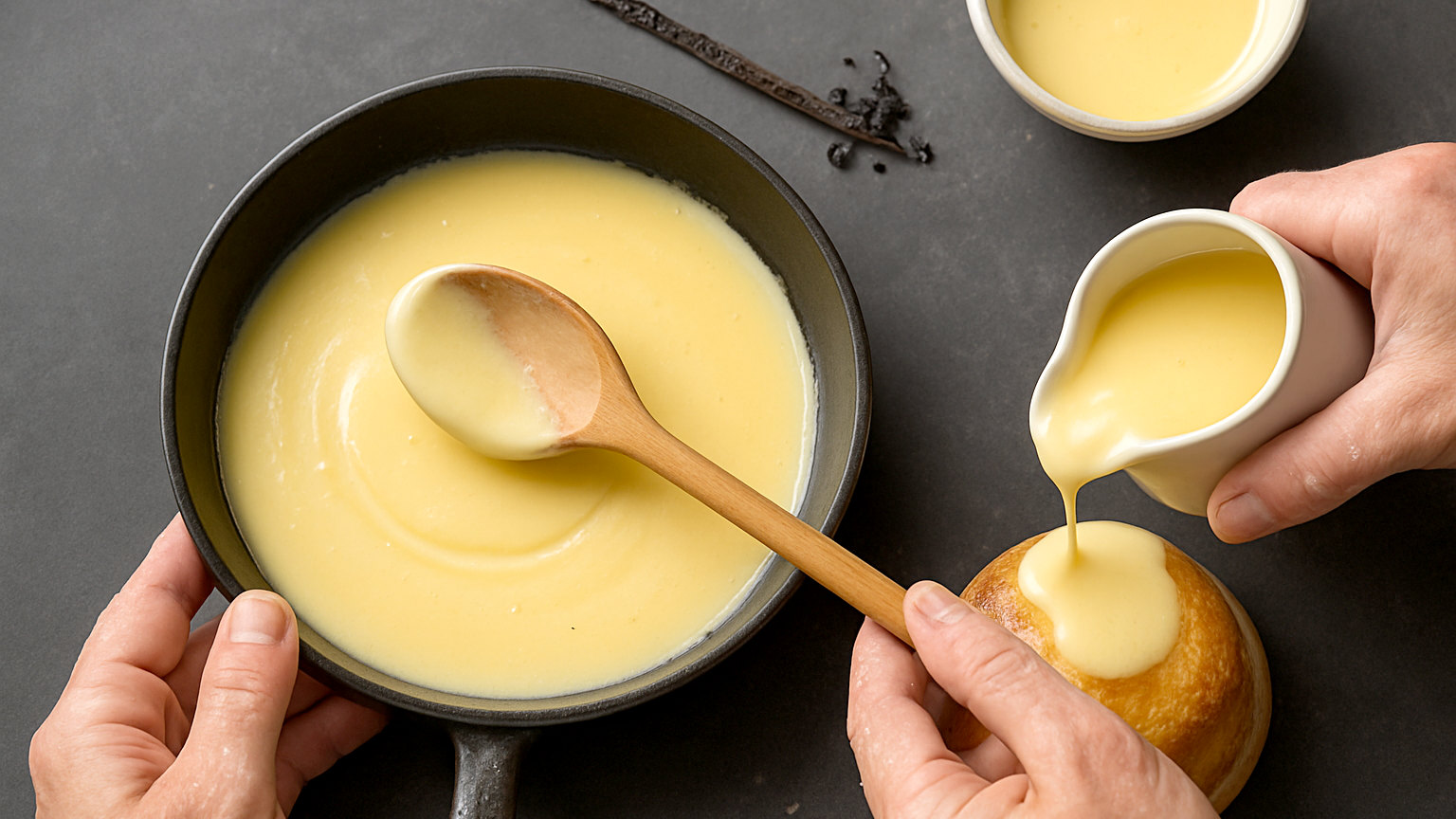
Custard is worth making in advance because reheating it gently is easy and the flavour is no worse for a night in the fridge. Freezing is a different matter. Both egg and starch custards suffer badly, which surprises people who assume anything can be frozen.
How long does each type keep?
- Pouring egg custard: 3 days refrigerated
- Custard powder custard: 3 days refrigerated
- Pastry cream: 3 days refrigerated
- Baked custards in ramekins: 3 days refrigerated
- Anything containing cream and fruit: 2 days
How should it be cooled?
Quickly. Pour it into a cold shallow bowl or tray, press cling film onto the surface and refrigerate within two hours.
A shallow layer cools far faster than a deep jug, which matters for both safety and texture.
How do you reheat it?
Gently, and never to a boil for an egg custard. Low heat with constant stirring, or short bursts in a microwave with a whisk between each.
A cornflour custard can be brought back to a boil safely, which makes it the easier one to reheat.
Can you make it the night before a meal?
That is the sensible approach for a trifle or anything assembled. Make the custard the day before, chill it, and build the pudding when it is cold.
For pouring custard, making it fresh on the day takes fifteen minutes and tastes better.
Why does it thicken in the fridge?
Starch gels and egg proteins firm as they cool. A custard that poured freely when warm will be almost solid the next day.
Whisk in a splash of warm milk as you reheat it.
Can you freeze custard?
Poorly. Egg custard separates on thawing into grainy solids and watery liquid, and pastry cream does the same more dramatically.
It is safe to eat and unpleasant to serve. Whisking or blending helps a little and does not fix it.
Can the components be prepared separately?
Infusing the milk can be done a day ahead and refrigerated, which removes twenty minutes from the process on the day.
Yolks and sugar should be whisked together only when you are ready to cook.
Is there anything that freezes?
Custard based ice cream, since freezing is the point of it. Custard folded into a mousse or a parfait also survives.
Anything that will be eaten frozen is fine. Anything meant to be poured is not.
What can you do instead?
Make it fresh, which takes fifteen minutes, or keep a tin of custard powder in the cupboard for the same purpose.
Custard powder keeps for a year and is the practical answer to wanting custard at short notice.
How do you stop a skin?
Cling film pressed directly onto the surface, or a disc of buttered paper. A skin forms because proteins dry where the custard meets the air.
It is harmless and easily strained out if it does form.
Should it be strained before storing?
Always. It catches any small set pieces and the vanilla pod, and it is far easier to do while the custard is warm than after it has chilled.
Can it be made in bulk?
Yes, and it scales cleanly. A large batch takes longer to thicken and needs more attention at the bottom of the pan.
Use a wide heavy pan rather than a deep one.
Can baked custards be made ahead?
Creme caramel improves after a night in the fridge, since the caramel dissolves into a sauce. Creme brulee keeps three days uncaramelised.
Torch the sugar only just before serving.
What about custard in an assembled pudding?
A trifle built to the custard layer keeps a day and improves. Once cream is on top, eat it within two days.
Keep anything containing custard refrigerated rather than at room temperature.
How many times can it be reheated?
Once, and it must be piping hot throughout. Take out only what you need and leave the rest refrigerated.
Discard anything that has stood at room temperature for more than two hours, in line with Food Standards Agency guidance.
Worth reading next: What to Do With Leftover Custard. There is more in our Puddings recipes.

