
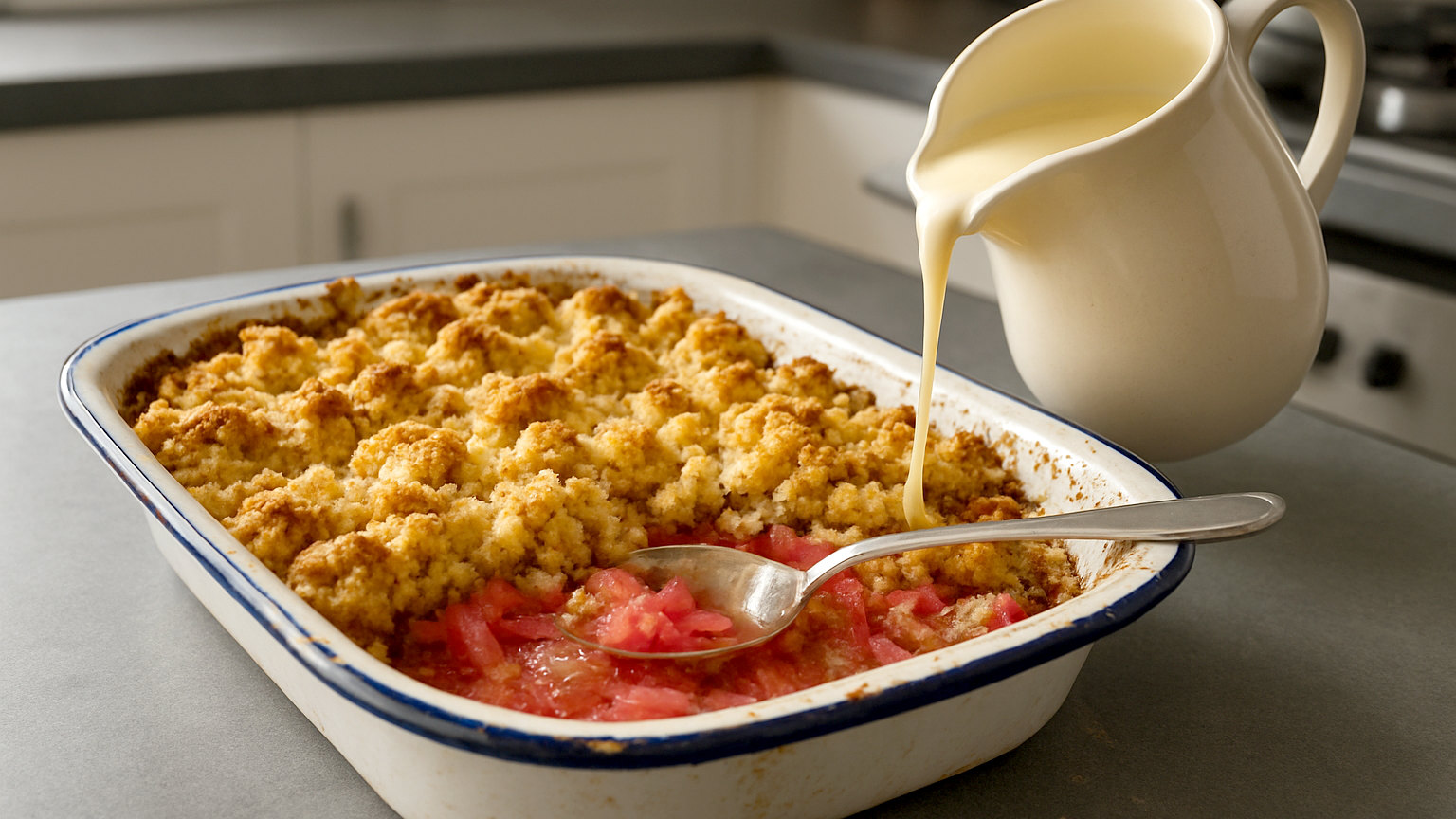
Rhubarb makes one of the best crumbles and it behaves quite differently from apple. It collapses almost completely and releases a great deal of liquid, which is why so many rhubarb crumbles end up with a soggy topping floating on a thin pink pool. The fix is straightforward: draw the liquid out before baking, or thicken it, or both.
What do you need for 6 people?
- 800g rhubarb, cut into 4cm lengths
- 120g caster sugar, plus 2 tablespoons for macerating
- 2 teaspoons cornflour
- Zest of 1 orange and a knob of stem ginger, chopped, optional
- 200g plain flour
- 100g cold butter, diced
- 75g demerara sugar
- 50g rolled oats
How do you make it?
- Toss the rhubarb with 2 tablespoons of sugar and leave for 30 minutes.
- Drain off the liquid that has collected and keep it.
- Mix the drained rhubarb with the remaining caster sugar, cornflour, orange zest and ginger.
- Tip into a baking dish, leaving room at the top.
- Rub the butter into the flour until it resembles coarse breadcrumbs.
- Stir in the demerara sugar and oats.
- Scatter over the fruit without pressing it down.
- Bake at 180C fan for 40 to 45 minutes until golden and bubbling at the edges.
Macerate and drain the rhubarb first. Half an hour with sugar draws out a surprising amount of liquid, and pouring that away is the single most effective thing you can do to keep the topping crisp.
What do you do with the drained juice?
Reduce it in a small pan until syrupy and serve it alongside, or stir it into custard. Throwing it away is a waste of the best flavour in the dish.
It also colours anything you add it to a striking pink.
How much sugar does rhubarb need?
More than most fruit. Around 150g per kilo is a starting point, and forced rhubarb needs slightly less than maincrop.
Taste a small piece raw. If it makes you wince, err upwards.
What is forced rhubarb?
Rhubarb grown in the dark in heated sheds, mostly in the Yorkshire triangle around Wakefield, and harvested by candlelight from January to March.
It is pale pink, tender and delicate, and it holds its shape better than the green maincrop rhubarb that follows in spring.
When is rhubarb in season?
Forced rhubarb from January to March, and outdoor maincrop from April through to about July.
Later season rhubarb is greener, more fibrous and considerably sharper, so it needs more sugar and a slightly longer bake.
Should the rhubarb be cooked first?
Not for a crumble. Forty five minutes in the oven is more than enough for rhubarb, which collapses very readily.
Pre cooking it would leave you with a puree by the time the topping was golden.
What goes well with rhubarb?
Ginger above all, in stem, ground or fresh form. Orange zest, vanilla and a little cinnamon all work.
Custard is the traditional accompaniment and the sharpness of the fruit suits it particularly well.
Why leave room at the top of the dish?
Rhubarb bubbles up considerably as it cooks, and a full dish will boil over onto the oven floor.
Put a tray underneath as insurance.
Should the strings be removed?
Young forced rhubarb needs nothing. Older maincrop stalks can be stringy, and the outer layer peels away easily with a small knife if it looks fibrous.
Never use the leaves, which contain oxalic acid and are toxic.
What should you serve with it?
Custard above all, which is the traditional partner and balances the sharpness. Cream, ice cream or Greek yoghurt all work.
The reduced pink syrup poured over the top is worth the extra pan.
Can it be made ahead?
Assemble it a day ahead and keep it in the fridge, baking from cold with an extra 10 minutes. It also freezes unbaked for three months.
Cool leftovers quickly, refrigerate within two hours and use within three days, in line with Food Standards Agency guidance.
If that was useful, Apple Crumble: The Classic Recipe and the Ratio covers related ground, and there is plenty more in Puddings recipes.

