
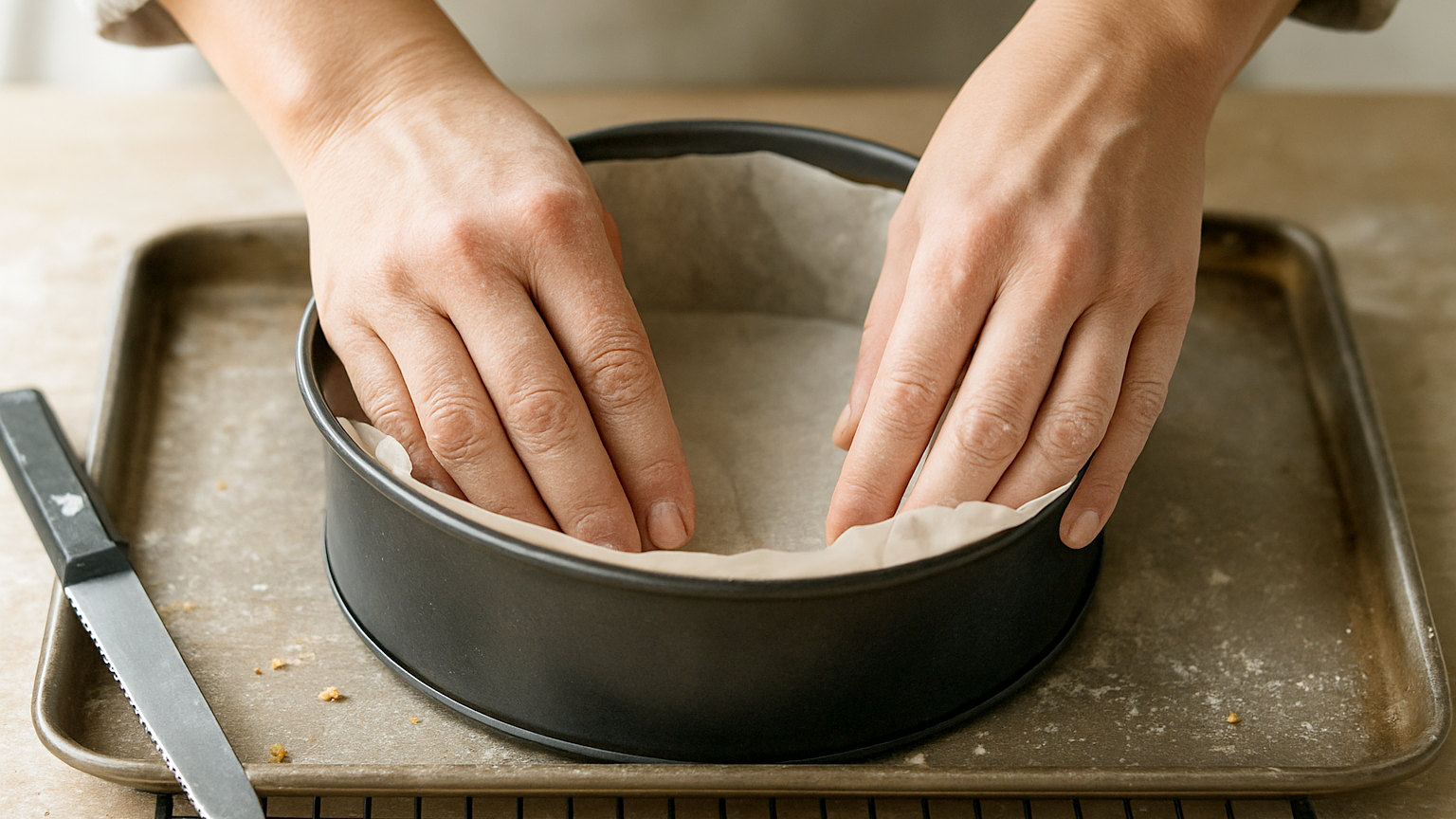
Lining is the small job that decides whether the cake comes out of the tin in one piece. How much lining a cake needs depends entirely on how long it will be in the oven: a sponge in for twenty five minutes needs almost nothing, and a fruit cake in for three hours needs protecting from the heat as well as from sticking.
What does a sponge tin need?
Grease the sides with butter and line the base with a disc of baking paper. That is all.
Do not line the sides of a sponge tin. The batter needs to grip the sides as it rises, and a paper collar lets it slide back down.
How do you cut a base disc?
Sit the tin on the paper, draw round it and cut just inside the line. Or fold a square into quarters, then into a triangle, measure from the point to the tin edge and cut.
Grease the tin first so the paper stays put.
What about a deep tin?
Line the base and the sides. Cut a strip about 5cm taller than the tin, snip along one long edge at 2cm intervals to a depth of 2cm, and press the snipped edge flat into the base.
The base disc then goes on top of the snipped tabs.
What does a fruit cake need?
A double layer of paper inside, standing 5cm above the rim, and a collar of brown paper or newspaper tied around the outside.
Three hours in the oven would otherwise burn the outside before the middle set.
How do you line a loaf tin?
Cut a strip the width of the base and long enough to overhang both long sides. Grease the tin, press the strip in, and the overhang becomes handles for lifting the cake out.
The short ends can be left ungreased or lightly buttered.
What about a Swiss roll tin?
Cut a rectangle larger than the tin, snip diagonally into each corner, and press it in so the corners overlap neatly.
The paper should stand slightly proud of the sides.
Should you grease and flour?
For an intricate bundt or ring tin where paper cannot go, yes. Brush with melted butter, dust with flour and tap out the excess.
For a chocolate cake, dust with cocoa instead so there is no white residue.
What if you have no baking paper?
Grease the tin thoroughly with butter and dust it with flour, tapping out the excess. It works for sponges and shallow cakes.
It is not enough for a fruit cake or anything baked for over an hour.
Does the type of paper matter?
Use baking parchment, which is silicone coated and non stick. Greaseproof paper is not the same thing and needs greasing.
Reusable silicone liners work well and last for years.
Do you still need to grease a lined tin?
Grease the tin lightly first so the paper sticks to it and stays flat while you spoon the batter in.
Paper that slides around traps batter behind it and gives a misshapen cake.
Can you use a loose bottomed tin?
Yes, and a base disc still helps. Wrap the outside in foil if the batter is very loose, since thin mixtures can seep out.
Do silicone tins need lining?
Not usually, though a base disc is still worth using for a delicate sponge. Silicone is flexible, so put it on a baking tray before filling it.
Cakes brown less in silicone than in metal, so expect a paler crust.
How much paper should stand above the rim?
Level with the rim for a sponge, and about 5cm above it for a fruit cake or anything that will be in the oven for over an hour.
The extra height shields the top as the cake rises.
When should the paper come off?
Peel it off while the cake is still slightly warm. Left until cold it can stick and tear the surface.
For a fruit cake, leave the lining on during storage since it protects the sides.
If that was useful, Cake Tin Sizes and How to Adapt a Recipe covers related ground, and there is plenty more in Puddings recipes.

