
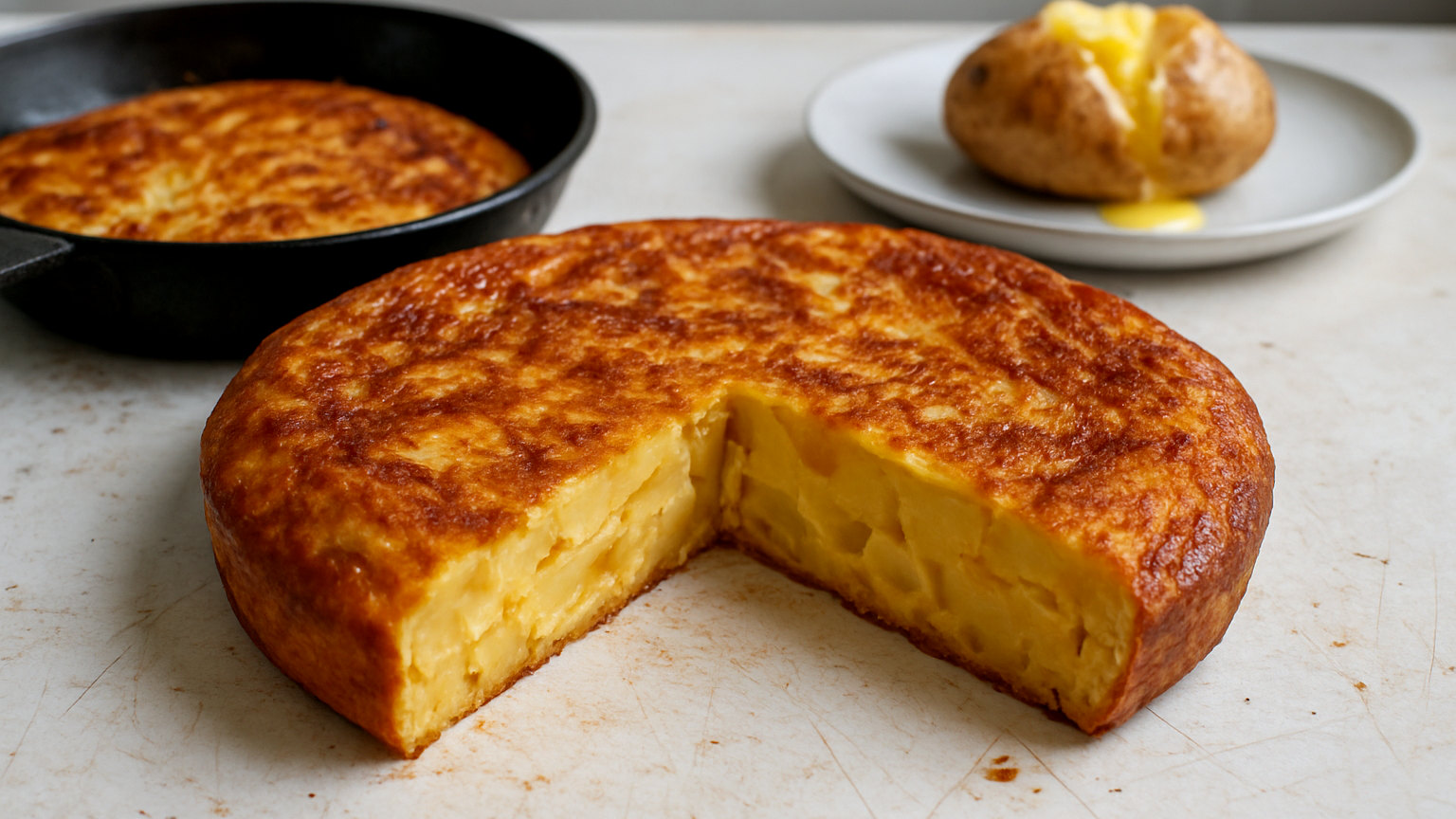
A Spanish omelette is a thick set cake of egg and potato that feeds four people from six eggs, is good hot, warm or cold, and uses up whatever is in the fridge. It is the most useful egg dish in this section for that reason. The potatoes are cooked slowly in oil rather than fried crisp, which is the step that distinguishes it from an ordinary omelette.
What do you need for 4 people?
- 600g waxy potatoes, peeled and sliced 3mm thick
- 2 onions, thinly sliced
- 150ml olive oil
- 6 large eggs
- Salt and black pepper
How do you make it?
- Heat the oil in a 24cm non stick pan over a medium low heat.
- Add the potatoes and onions with a good pinch of salt.
- Cook gently for 20 to 25 minutes, turning occasionally, until soft but not browned.
- Drain in a sieve set over a bowl, keeping the oil.
- Beat the eggs in a large bowl, season well, and stir in the warm potatoes.
- Leave to stand for 10 minutes.
- Heat 2 tablespoons of the reserved oil in the pan and pour in the mixture.
- Cook over a low heat for 8 minutes, then finish under a medium grill for 3 minutes or turn it out and flip it back in.
The potatoes should not brown. They are being poached in oil rather than fried, which gives the soft, almost creamy texture the dish depends on. Crisp potatoes make a different and inferior thing.
Why let the mixture stand?
The potato absorbs some of the egg and the whole mixture settles, which gives a more cohesive omelette that holds together when cut.
Ten minutes is enough and it also lets the potatoes cool slightly so they do not scramble the egg.
Should you turn it or grill it?
Turning it out onto a plate and sliding it back in is traditional and gives an even finish on both sides. It also risks disaster.
Finishing under the grill is easier and the result is very nearly as good.
Which potatoes should you use?
Waxy varieties such as Charlotte or Desiree, which hold their shape. Floury potatoes break down and the omelette becomes mushy.
This is the opposite of what you would want for roasting or mashing.
Is that a lot of oil?
Most of it is drained off and reused, so far less ends up in the finished dish than the quantity suggests.
Keep the strained oil for frying, since it has taken on flavour from the potato and onion.
Should there be onion in it?
This is a long standing argument in Spain, where a tortilla with onion and one without have committed defenders on both sides.
Onion gives sweetness and moisture, and without it the dish is plainer and more purely about potato and egg.
What is the difference from a frittata?
A frittata is the Italian version and usually contains cheese and a wider range of vegetables, and it is generally finished in the oven.
The method is close enough that the distinction matters more to purists than to cooks.
What can you add?
Chorizo, peppers, spinach, peas, leftover roast vegetables or any cooked meat. Cheese if you are making a frittata rather than a tortilla.
Cook anything wet separately and drain it first.
How thick should it be?
Around 3cm to 4cm in a 24cm pan, which is what six eggs and 600g of potato gives. Thicker than that and the centre stays raw while the outside sets.
Use a larger pan for a bigger quantity rather than a deeper omelette.
How do you know it is set?
The edges should be firm and the centre should have only the faintest wobble. It carries on setting for a few minutes after it leaves the heat.
In Spain a slightly soft centre is preferred, which is worth trying.
Is it good cold?
Better than most egg dishes, which is why it is standard picnic and tapas food. Cut it into squares and eat it at room temperature.
Cool it quickly, refrigerate within two hours and use within two days, in line with Food Standards Agency guidance.
Next, try The Ploughmans and Other Assembled Suppers, or see the rest of our Mains recipes.


