
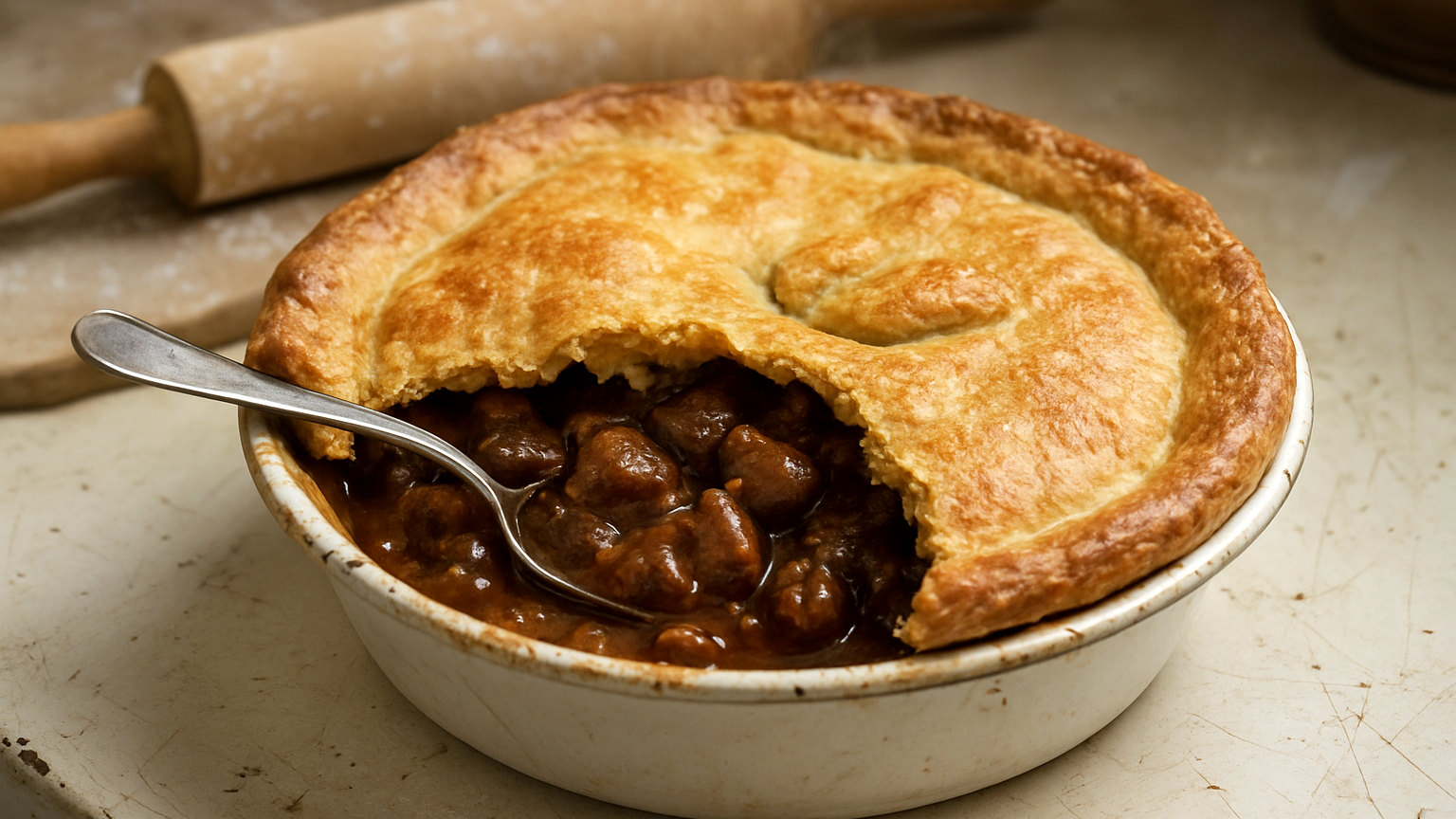
Steak and kidney pie is the deepest flavoured of the British meat pies, and the kidney is the reason. It contributes a mineral, faintly metallic richness that beef alone cannot produce. It is also what puts people off, almost always because it was not prepared properly. Soaked, trimmed and browned hard, it loses the harshness entirely.
What do you need for 6 people?
- 800g braising steak or beef shin, cut into 3cm cubes
- 250g ox or lambs kidney, trimmed and chopped
- 200ml milk, for soaking the kidney
- 2 onions, chopped, and 200g mushrooms, quartered
- 3 tablespoons plain flour, seasoned
- 2 tablespoons beef dripping
- 500ml beef stock and 200ml stout
- 2 tablespoons Worcestershire sauce and 2 bay leaves
- 375g puff pastry and 1 beaten egg
How do you prepare the kidney?
Cut it in half, snip out the white core with scissors, then soak the pieces in milk for an hour. Drain and pat dry before cooking.
The soak is what removes the harshness. Kidney cooked straight from the packet has a strong ammoniac edge, and that single hour in milk is the difference between a rich pie and one nobody finishes.
How do you make the filling?
- Toss the steak and kidney in the seasoned flour.
- Brown them hard in the dripping in batches, setting each aside.
- Soften the onions in the same pan for 10 minutes, then add the mushrooms.
- Pour in the stout and let it bubble down by half, scraping the base.
- Return the meat, add the stock, Worcestershire sauce and bay.
- Cover and simmer very gently for 2 and a half to 3 hours, or cook at 150C fan.
- Uncover for the last 30 minutes so the gravy reduces and thickens.
- Cool completely, ideally overnight in the fridge.
How do you assemble and bake it?
Tip the cold filling into a pie dish, top with rolled puff pastry, seal the edges against the rim and cut a steam hole. Glaze with beaten egg.
Bake at 200C fan for 30 to 35 minutes until the pastry is deep golden and risen.
Why brown the meat in batches?
A crowded pan drops in temperature and the meat steams in its own juices rather than browning. Browning is where a large part of the flavour comes from.
Give each batch room and let it colour properly before turning.
Which cut of beef is best?
Shin gives the richest result, since it is full of collagen that turns to gelatine over three hours and thickens the gravy on its own.
Braising steak and chuck both work well. Avoid anything lean, which will be dry however long it cooks.
Ox or lambs kidney?
Ox kidney is traditional, stronger and cheaper, and it stands up to three hours of braising. Lambs kidney is milder and more tender and suits people trying it for the first time.
Pigs kidney is the strongest of the three and is worth avoiding here.
Why does the filling need cooling overnight?
The flavour improves, the gravy sets, and cold filling means the pastry lid can be applied without melting. All three matter.
It also splits the job across two days, which makes it far less of an undertaking.
Should there be a pastry base?
Traditionally this is a lidded pie. If you want a full case, blind bake a shortcrust base and use puff only on top.
Puff pastry underneath a gravy filling will always go soggy, whatever else you do.
What can you use instead of stout?
Red wine, brown ale, or extra beef stock with a tablespoon of balsamic vinegar. Strong black tea is an old substitute that adds tannin without sweetness.
Whatever you use, reduce it hard before the stock goes in so the raw alcohol or acidity cooks off.
What about steak and kidney pudding?
The same filling in a suet pastry basin, steamed for four hours. It is a different dish and arguably the better one, though it takes far longer.
Cool leftovers quickly, refrigerate within two hours and use within two days, in line with Food Standards Agency guidance.
If that was useful, Steak and Ale Pie: A Proper Recipe With Real Pastry covers related ground, and there is plenty more in Mains recipes.


