
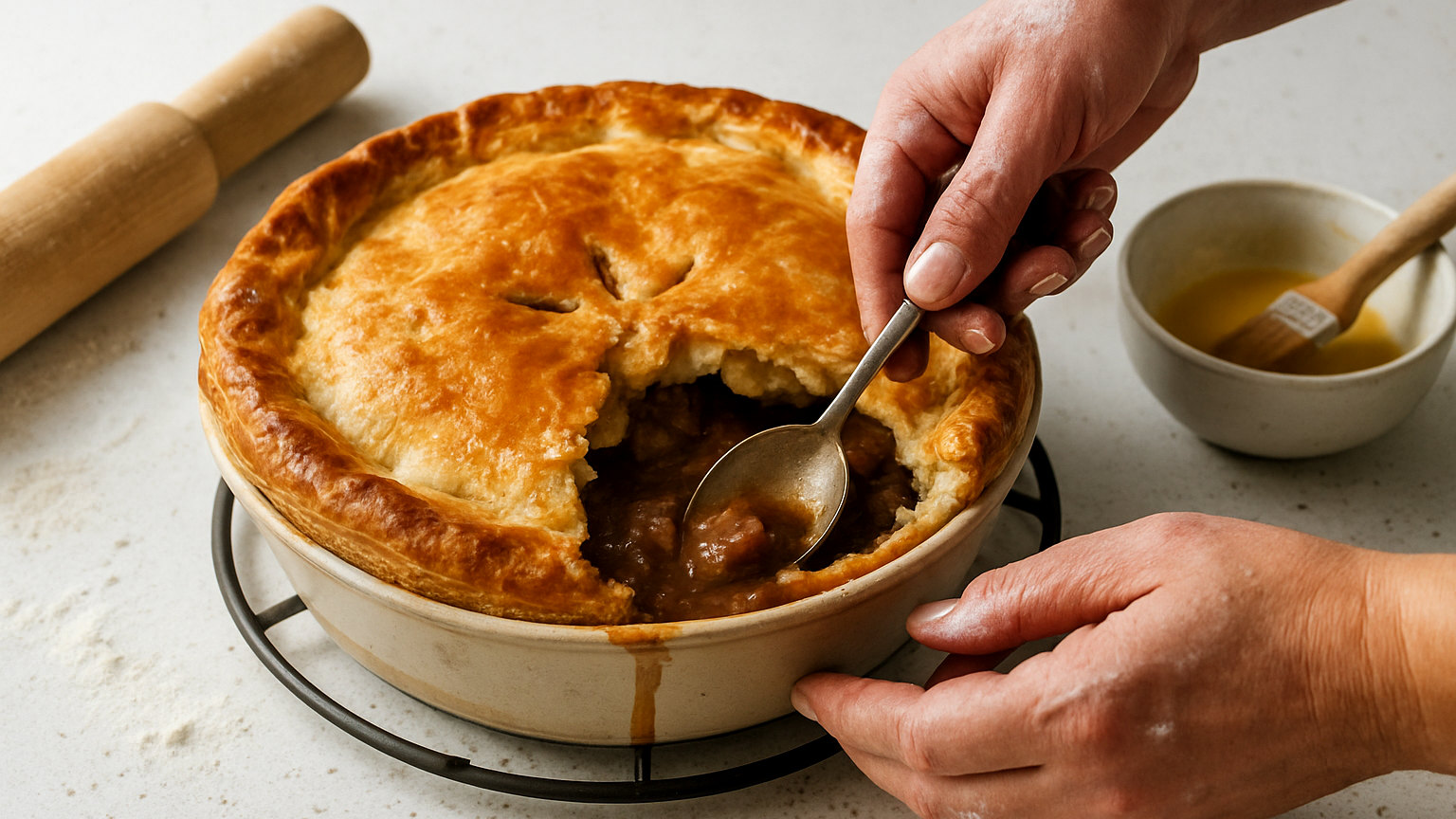
A soggy pie bottom is the single most common British pie failure, and it happens because pastry and wet filling are in direct contact for forty minutes in an oven. There are four defences and they work together rather than individually. Using one of them usually helps a bit. Using all four solves it.
Why does it happen?
Liquid from the filling soaks into the raw pastry before the heat can set it. Once the starch in the flour has absorbed water it will never crisp, however long the pie stays in the oven.
The base is also the coldest part of the pie, sitting against a dish that heats slowly, so it sets last and absorbs longest.
Should you blind bake the base?
For any pie with a wet filling, yes. Line the tin, chill it, prick the base, cover with baking paper and beans, and bake at 190C fan for 15 minutes.
Then remove the beans and bake for another 8 minutes. This second stage is the one people skip, and it is the stage that actually dries and sets the base rather than just cooking the sides.
Does the filling need to be cold?
Completely cold, and this matters as much as blind baking. Warm filling melts the fat in the pastry before the oven can set it, which is what produces a greasy, doughy base.
Make the filling the day before if you can. It also tastes better for the wait.
What difference does the tin make?
A great deal. Metal conducts heat quickly and sets the base fast. Ceramic and glass dishes heat slowly, so the pastry sits wet for longer.
Use a metal pie tin, ideally a dark one, and put it on a preheated baking tray so the base gets heat from below immediately.
Can you seal the pastry?
Yes, and it is worth doing. Brush the blind baked base with beaten egg and return it to the oven for two minutes, which forms a waterproof layer.
A scattering of semolina, fine breadcrumbs or grated hard cheese on the base absorbs any liquid that does get through.
How thick should the filling be?
Thicker than you would want to eat as a stew. It loosens in the oven, and a filling that pours freely will find its way into the pastry.
Reduce the gravy hard before assembling, or thicken it with a little cornflour.
Which shelf should the pie go on?
The bottom shelf, or the floor of the oven in a gas oven. Heat rises, and the base needs more of it than the lid does.
Putting a pie on the middle shelf browns the lid beautifully and leaves the base underdone.
Does the pastry recipe matter?
Shortcrust resists moisture far better than puff, which is why traditional pies use shortcrust underneath and puff only on top.
A slightly higher fat content also helps, since fat repels water. Half fat to flour is the ratio to aim for.
Should you cut a hole in the lid?
Always. A steam hole lets moisture escape upwards rather than condensing inside and dripping back onto the base.
A pie funnel does the same job more elegantly and also supports the lid so it does not sag into the filling.
Does an egg wash help or hurt?
On the lid it helps, giving colour and shine. On the base it helps only if it is applied to blind baked pastry and set in the oven before the filling goes in.
Brushing raw pastry with egg and then filling it immediately achieves nothing, since the egg has not had a chance to form a barrier.
What if it is already soggy?
Return it to a hot oven at 200C fan on the bottom shelf for 10 to 15 minutes, which will drive off some moisture and firm the base.
It will improve rather than transform. The defences all have to go in before the pie is baked.
For something along the same lines, see Chicken and Leek Pie With a Puff Lid, or browse all our Mains recipes.


