
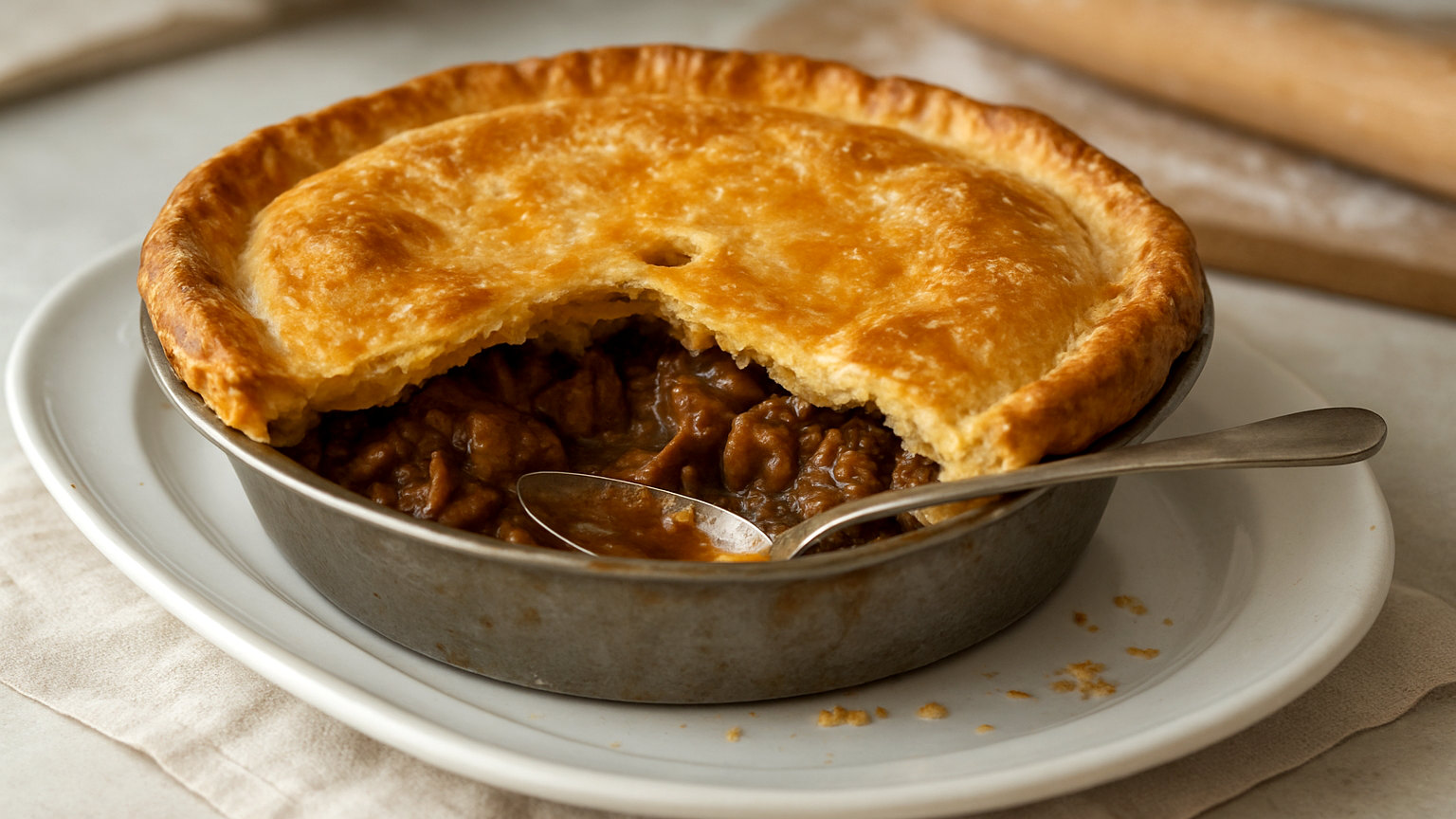
Pie dishes are sold in a confusing range of sizes and materials, and the choice affects the result more than most people expect. The material decides whether the base crisps, and the depth decides how much filling you can get in without the lid sagging. Width alone is a poor guide to how many a pie will feed.
How many does each size feed?
- 18cm round: 3 to 4 people, about 600g filling
- 23cm round: 6 people, about 1kg filling
- 28cm round: 8 people, about 1.5kg filling
- 20cm by 30cm rectangular: 8 people, about 1.5kg filling
These assume a depth of around 5cm, which is standard for a British pie dish.
How much pastry does each need?
For a lid only on a 23cm dish, 375g of puff pastry, which is one standard shop bought block. For a base and lid, about 500g of shortcrust made from 300g of flour.
Roll to 3mm for a base and 4mm for a lid. Thicker pastry does not bake through properly in the time the filling needs, and thinner tears when it is lifted.
Metal or ceramic?
Metal for anything with a pastry base, since it conducts heat quickly and sets the base before it can absorb liquid.
Ceramic and enamel dishes look better on the table and are perfectly good for lidded pies and mash topped pies, where there is no base to worry about.
Does the colour matter?
A dark metal tin absorbs heat better than a shiny one and browns the base more. A well used darkened tin outperforms a new bright one.
Glass dishes are the slowest of all and should be avoided for pastry bases.
Why does depth matter?
A shallow dish gives a poor ratio of filling to pastry and dries out. A very deep one leaves the lid unsupported in the middle, where it sags into the filling.
Around 5cm is the useful range. Fill the dish almost to the rim so the pastry has something to rest on.
What is the rim for?
Traditional pie dishes have a wide flat rim so a strip of pastry can be stuck down and the lid sealed onto it. That double layer holds the lid in place as it rises.
Without a rim, the lid can slide off or shrink back into the dish.
Do you need a pie funnel?
It supports the centre of the lid and lets steam escape, which prevents both sagging and a wet filling. A small upturned egg cup does the same job.
Failing either, cut a generous steam hole in the middle of the lid.
Can you use a cake tin?
A loose bottomed sandwich tin or springform tin works well for deep enclosed pies, and the removable base makes turning the pie out much easier.
This is the standard approach for raised pies made with hot water crust.
How do you scale a recipe up or down?
Filling scales by volume, so a 28cm dish needs roughly one and a half times a 23cm recipe. Pastry scales by area, which is closer to one and a half as well.
Cooking time increases only slightly, since the depth is unchanged. Add about 10 minutes for the larger dish.
Does a mash topped pie need a special dish?
No, and ceramic is the better choice here since there is no base to crisp. A wide shallow dish gives more browned surface than a deep narrow one.
Allow room at the top, since the filling bubbles up around the edges as it heats.
How do you get the pie out?
Loose bottomed tins are the simplest answer. Otherwise run a knife around the edge while the pie is still warm and let it settle for ten minutes before lifting.
What about individual pies?
Small foil cases or a muffin tin work, and the baking time drops to around 25 minutes. They need proportionally more pastry.
Individual pies freeze better than one large one and reheat far more quickly.
For something along the same lines, see Do You Need to Blind Bake a Pie Base?, or browse all our Mains recipes.


