
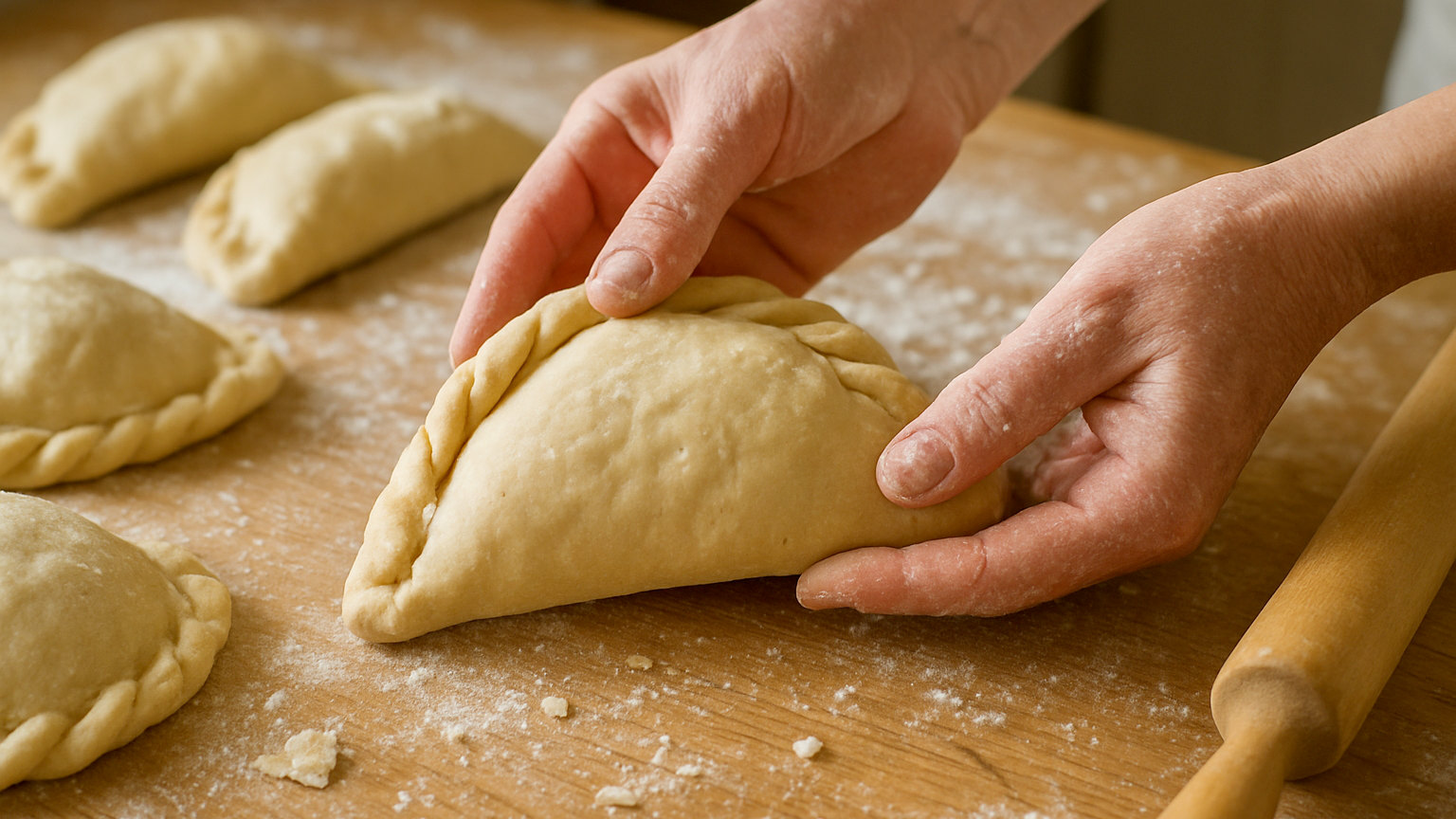
A cheese and onion pasty is the standard vegetarian option in every British bakery and it is easy to make badly. Cheese melts to liquid, onions release water, and the two together will flood the pastry and burst out of the crimp. The fix is to cook the onions down first and to add potato, which absorbs whatever moisture remains.
What do you need for 4 pasties?
- 1 quantity of pasty pastry made from 500g strong flour
- 3 large onions, thinly sliced
- 40g butter
- 350g floury potatoes, peeled and diced into 1cm cubes
- 300g mature cheddar or Lancashire, coarsely grated
- 2 teaspoons English mustard
- 2 tablespoons chopped parsley or chives
- 1 beaten egg for glazing
- Salt and plenty of black pepper
How do you make them?
- Melt the butter and cook the onions slowly for 25 minutes until soft, sweet and completely dry.
- Boil the diced potato for 7 minutes until just tender, then drain and steam dry thoroughly.
- Combine the onions, potato, cheese, mustard and herbs and season heavily.
- Cool completely before assembling.
- Roll the pastry into 4 circles about 20cm across.
- Pile the filling on one half, leaving a 2cm border.
- Brush the edge with water, fold over and crimp firmly.
- Glaze with egg, cut a steam hole and bake at 190C fan for 35 to 40 minutes.
Cook the onions until the pan is completely dry. Half cooked onions release their water inside the pasty, and that water has nowhere to go except through the pastry or out of the crimp.
Why add potato?
It bulks the filling out, absorbs the fat released by the cheese and stops the whole thing collapsing into a single greasy layer.
It is standard in the northern bakery versions and it makes a noticeable difference.
Which cheese works best?
A strong crumbly cheese. Lancashire is the traditional choice and melts beautifully. Mature or extra mature cheddar is the easy substitute.
Avoid mild cheddar, which disappears entirely, and anything wet such as mozzarella.
Why does the filling need to be cold?
Warm filling melts the fat in the pastry before the oven can set it, which produces a greasy base and a weak seal.
Make the filling the day before if you can, which also improves the flavour.
Why is the bake shorter than a Cornish pasty?
Because the filling is already cooked. It needs only long enough to heat through and melt the cheese, which is about 35 minutes.
A Cornish pasty contains raw beef and swede and needs nearly an hour.
Does it need mustard?
It sharpens the cheese and stops the filling being bland, and a couple of teaspoons is not detectable as mustard in the finished pasty.
A dash of Worcestershire sauce does a similar job, though check the brand if it needs to be vegetarian.
What else can go in?
Leek in place of some of the onion, a spoonful of chutney or piccalilli, chopped spring onion, or a little grated apple.
Keep additions dry, since anything wet undoes the work of cooking the onions down.
Why is it a northern dish?
It grew up around the Lancashire and Cheshire cheese trade and the bakery counter, where a cheap filling meal without meat had an obvious market.
It remains far more common in the north than the south, and many southern bakeries do not sell it at all.
How many does this make?
Four large pasties, each a full meal, or six smaller ones for lunchboxes. The filling scales cleanly.
Allow about 250g of filling per large pasty and no more, since overfilling forces the crimp open.
Are they good cold?
Arguably better, which is how bakeries sell them. The filling firms up and they slice cleanly, which makes them excellent picnic and lunchbox food.
Can they be frozen?
Yes, raw and assembled, for three months. Bake from frozen at 180C fan for about 50 minutes.
Cool baked leftovers quickly, refrigerate within two hours and use within two days, in line with Food Standards Agency guidance.
Worth reading next: Vegetable Pasty With Root Vegetables and Lentils. There is more in our Mains recipes.


