
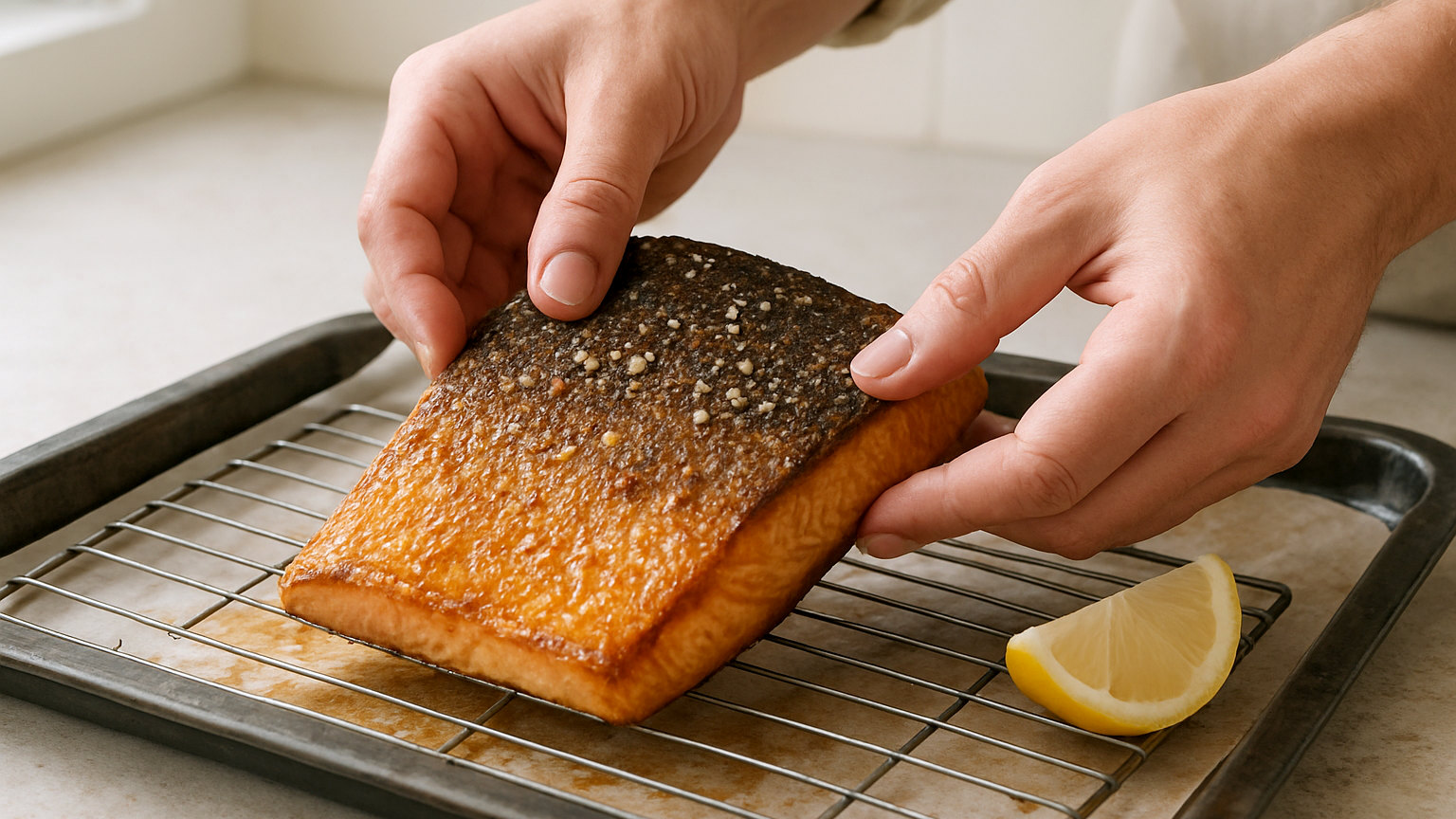
Salmon is the fish most often overcooked in British kitchens, partly because it is forgiving enough that nobody notices immediately and partly because people cook it until it is uniformly pale. A fillet taken off the heat with a darker band still in the middle finishes cooking on the plate and is considerably better for it.
What do you need for 2 people?
- 2 salmon fillets, skin on, about 150g each
- 1 tablespoon oil with a high smoke point
- A knob of butter
- Half a lemon
- Flaky salt and black pepper
How do you pan fry it?
- Take the salmon out of the fridge 15 minutes ahead and pat the skin completely dry.
- Season the skin generously with salt.
- Heat the oil in a heavy pan over a medium high heat.
- Lay the fillets in skin side down, pressing each flat for 10 seconds with a spatula.
- Cook for 5 to 6 minutes without moving them, until the skin is crisp and the flesh has turned pale two thirds of the way up.
- Turn and cook for 1 to 2 minutes only.
- Add the butter and a squeeze of lemon, spoon over and remove from the pan.
- Rest for 2 minutes before serving.
Press the fillets flat for the first ten seconds. Salmon skin contracts as it hits the heat and lifts the middle of the fillet away from the pan, which is why the skin crisps at the edges and stays flabby in the centre.
Why cook it mostly on the skin?
The skin protects the flesh from direct heat, so the fillet cooks gently from below while the surface crisps. Cooking it flesh side down for long dries it out quickly.
Roughly five parts skin side to one part flesh side is the right proportion.
How do you know when it is done?
Look at the side of the fillet. The pale opaque cooked flesh works its way up from the bottom, and you want a band of darker colour still visible in the middle when it comes off.
Around 50C to 55C in the centre gives a slightly pink middle. Cook to 63C throughout for anyone in a vulnerable group.
How do you bake it?
At 180C fan for 12 to 15 minutes for a 150g fillet, on an oiled tray. This is the easiest method for several fillets at once.
The skin will not crisp, so remove it before serving or start it in a pan and finish in the oven.
Can it be poached?
Yes, in barely simmering water or stock with a bay leaf and lemon for 8 to 10 minutes. It gives a very moist result and is the traditional way to cook a whole side for a cold buffet.
Keep the liquid below a simmer, since boiling toughens it and squeezes out albumin.
What is the white stuff that appears?
Albumin, a protein forced out as the fibres contract. A lot of it means the heat was too high.
It is harmless, and it is a useful sign to lower the heat next time.
Can you cook it from frozen?
In the oven, yes, at 180C fan for about 25 minutes. In a pan it releases too much water to crisp the skin.
Defrosting in the fridge overnight gives a noticeably better result.
Should you buy farmed or wild?
Most salmon sold in Britain is farmed, and quality varies considerably by producer. Wild salmon is leaner, firmer and expensive, and it overcooks faster because there is less fat.
Reduce the cooking time by a minute or two for wild fish.
Should you eat the skin?
Crisped properly it is one of the best parts, and it is where a good deal of the flavour sits. Soft flabby skin is worth removing.
If you are baking or poaching, take the skin off before serving since it will not have crisped.
What should you serve with it?
New potatoes, greens and something sharp such as lemon, capers or a herb sauce. Salmon is rich and needs acidity.
Cool leftovers quickly, refrigerate within two hours and use within two days.
If that was useful, Whole Baked Sea Bass With Lemon and Herbs covers related ground, and there is plenty more in Mains recipes.


